
Key Takeaways:
- Squeeze pins effectively eliminate internal shrinkage in thick-wall aluminum sections.
- Precise timing and pressure control are critical to prevent flash or premature solidification.
- Not a universal solution; requires validation based on specific part geometry and alloy flow.
Introduction: Controlling Internal Defects in Aluminum Die Castings
Die casting shrinkage porosity is one of the most common internal quality challenges in aluminum die casting, especially for OEM components requiring high strength, pressure tightness, and long-term reliability. Unlike surface defects, internal shrinkage often remains hidden during visual inspection and is only exposed during subsequent CNC machining, pressure testing, or final assembly. For components with thick-wall sections or localized heat accumulation, local squeeze pin technology serves as an effective method to mitigate internal porosity. However, it is not a universal solution and requires precise optimization based on part geometry, alloy characteristics, and mold design.
1. Understanding Die Casting Shrinkage Porosity in Aluminum Components
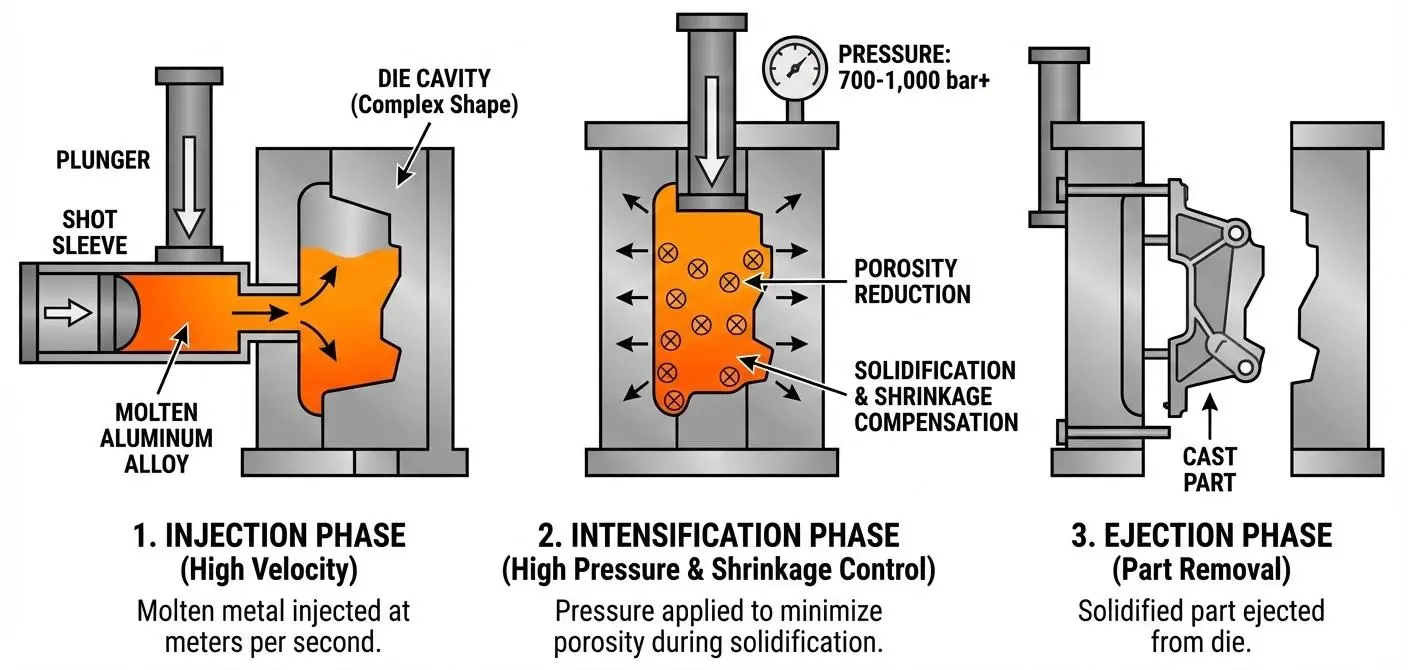
During the high-pressure die casting process, molten aluminum fills the mold cavity at high speed and rapidly solidifies.
As the aluminum alloy changes from liquid to solid state, material naturally contracts.
Under normal conditions, the feeding effect from the remaining molten metal can compensate for this shrinkage.
However, problems may occur in areas with:
- Thick wall sections
- Large material accumulation
- Sudden changes in wall thickness
- Poor feeding conditions
- Local hot spots during solidification
In these areas, solidification may happen before sufficient liquid metal reaches the shrinking zone, resulting in internal voids.
These defects are commonly known as:
Shrinkage porosity
Why Internal Porosity Matters for OEM Components
Reduced Mechanical Performance
Internal voids can create stress concentration points, reducing the ability of components to withstand repeated loading or impact.
Pressure Leakage Risk
For components requiring sealing performance, internal porosity may cause leakage during:
- Air tightness testing
- Hydraulic pressure testing
- System operation
Machining-Related Quality Issues
Some internal defects remain hidden until machining removes the surface material.
This can lead to:
- Unexpected rejection
- Additional processing costs
- Production delays
Therefore, controlling internal casting quality is critical for demanding OEM applications.
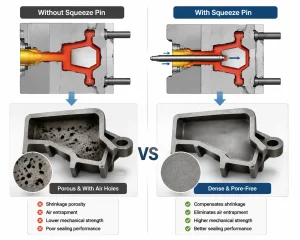
Internal Structure Comparison: Conventional Die Casting vs. Local Squeeze Optimization
2. How Local Squeeze Pin Technology Works
Applying Additional Pressure to Targeted Areas During Solidification
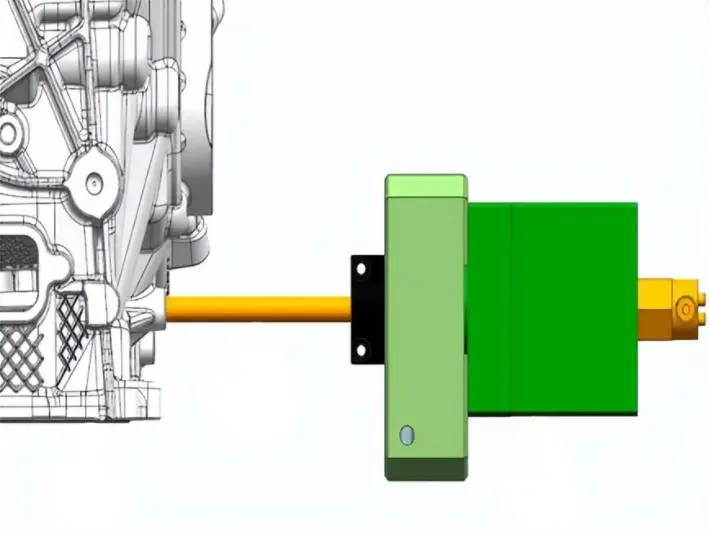
Local squeeze technology uses hydraulic squeeze pins integrated into the die casting mold to provide additional pressure in specific areas where shrinkage risk exists.
During the semi-solidification stage, the squeeze pin applies localized pressure to directly prevent die casting shrinkage porosity in critical thick sections.
This additional pressure helps:
- Compensate for local solidification shrinkage
- Improve material density in critical areas
- Reduce the formation of shrinkage cavities
- Improve casting consistency


- Unlike general injection pressure, squeeze pin technology provides localized pressure compensation rather than applying additional pressure throughout the entire casting.
When Is Local Squeeze Technology Suitable?
Local squeeze technology is commonly considered when:
- A specific area has a high risk of shrinkage
- The component contains thick sections
- Local mechanical performance is critical
- Pressure tightness is required in certain areas
- CNC machining may expose internal defects
The technology is usually applied selectively based on part requirements.
Local squeeze pin technology is one of the most effective solutions to reduce die casting shrinkage porosity in thick-wall sections.
3. Local Squeeze Technology Is Part of a Complete Die Casting Solution
Squeeze pins alone cannot solve every casting issue.
Before applying local squeeze technology, engineers must first evaluate the overall casting process, including:
- Part design
- Alloy selection
- Mold structure
- Filling behavior
- Cooling conditions
Some common defects require different solutions.
For example:
| Casting Issue | Typical Solution |
|---|---|
| Shrinkage porosity in local thick areas | Local squeeze technology |
| Poor filling / misrun | Runner and gate optimization |
| Cold shut defects | Filling temperature and flow adjustment |
| Gas porosity | Improved venting and process control |
| Dimensional instability | Mold and cooling optimization |
A successful die casting project requires selecting the right solution for the actual defect mechanism.
4. Key Process Factors in Controlling Die Casting Shrinkage Porosity
Squeeze Pin Location Design
The position of the squeeze pin is one of the most important factors.
Engineers need to identify potential shrinkage areas through:
- Part structure analysis
- Mold flow simulation
- Solidification analysis
The squeeze pin should be placed where additional pressure can effectively improve local feeding conditions.
Pressure and Timing Control
Important parameters include:
- Squeeze pressure
- Delay time
- Holding time
The timing must match the solidification behavior of the aluminum alloy.
Applying pressure too early or too late may reduce the expected improvement.
Integration with Filling and Cooling Optimization
Local squeeze technology works best when combined with:
- Optimized runner design
- Proper gate location
- Injection parameter control
- Mold temperature management
- Cooling system optimization
The goal is not only to add a squeeze pin, but to create a balanced and stable casting process.
5. Manufacturing Benefits of Properly Applied Local Squeeze Technology
Proper application of squeeze pins directly addresses die casting shrinkage porosity and improves structural integrity.
Proper implementation of squeeze pins directly reduces die casting shrinkage porosity, yielding measurable quality improvements:
Typical improvements include:
| Performance Area | Conventional Process | With Local Squeeze Applied to Critical Areas |
|---|---|---|
| Local shrinkage risk | Higher risk in thick sections | Reduced risk in targeted areas |
| Internal density | Possible localized defects | Improved local structure consistency |
| Pressure tightness | Potential leakage issues | Improved reliability |
| Mechanical performance | Limited by internal defects | Better consistency |
Actual results depend on:
- Aluminum alloy type
- Part design
- Wall thickness
- Mold design
- Process parameters
Engineering validation is required for each OEM project.
6. Supporting Manufacturing Controls for Reliable Die Cast Components
Local squeeze technology is only one element of a complete die casting quality system.
RuiYu supports OEM projects through integrated aluminum die casting services, including mold development, die casting production, machining, and surface finishing.
Engineering and Mold Development
A reliable die casting process starts with proper die casting mold development.
Before production, engineers evaluate:
- Part design feasibility
- Filling behavior
- Solidification patterns
- Potential hot spots
- Mold structure optimization
Through DFM analysis and mold flow simulation, potential casting risks can be identified and reduced before tooling production.
Die Casting Process Optimization
Including:
- Filling parameter adjustment
- Mold temperature control
- Cooling optimization
- Defect analysis
Secondary Processing and Quality Control
Including:
- CNC machining
- Surface finishing
- Assembly
- Dimensional inspection
- Functional testing
This integrated approach helps customers achieve stable quality from prototype development to mass production.
7. Applications Where Local Squeeze Technology Can Provide Benefits
Local squeeze technology is most valuable for aluminum die cast components where specific areas require improved density or reliability.
Typical examples include:
Electric Motor Components
Examples:
- Motor housings
- End covers
- Structural supports
Requirements:
- Dimensional stability
- Heat dissipation
- Long-term operating reliability
Industrial Equipment Components
Examples:
- Pump housings
- Valve bodies
- Mechanical housings
- Structural brackets
Requirements:
- Pressure resistance
- Mechanical strength
- Consistent production quality
Complex OEM Aluminum Components
Applications requiring:
- Lightweight design
- High rigidity
- Complex geometry
- Reduced machining defects
may benefit from optimized die casting solutions.
Why Choose RuiYu for Complex Die Casting Projects?
Reliable die casting requires more than equipment capability.
RuiYu helps OEM customers develop metal components through:
- Engineering support
- Mold development coordination
- Die casting process optimization
- CNC machining
- Surface finishing
- Assembly solutions
With more than 20 years of die casting experience, RuiYu focuses on solving manufacturing challenges and delivering reliable OEM components.
Frequently Asked Questions
Frequently Asked Questions
Q1: Can squeeze pins eliminate all die casting shrinkage porosity problems?
A: No. Local squeeze technology is specifically designed to reduce localized shrinkage risks in critical thick-wall areas. Other casting defects require different engineering solutions—such as runner/gate optimization for misruns, or improved venting for gas porosity.
Q2: When should engineers specify squeeze pins to prevent die casting shrinkage porosity?
A: It is typically considered during DFM for components with heavy wall sections, localized hot spots, strict pressure tightness requirements, or critical load-bearing areas where internal density is paramount.
Q3: Is squeeze pin technology suitable for every die casting part?
A: No. Application depends on part geometry, alloy selection, production volume, and cost considerations. Engineering evaluation is necessary before implementation.
Facing die casting shrinkage porosity or pressure leakage challenges in your aluminum components? Contact RuiYu’s engineering team today.
If your aluminum die cast parts experience:
- Internal shrinkage issues
- Pressure leakage problems
- Machining defects
- Strength limitations
RuiYu can help evaluate your design and recommend suitable manufacturing solutions.
Send your CAD drawings (STEP/IGES files) to RuiYu engineering team for DFM review and die casting process recommendations.
