
A practical engineering guide for OEM buyers preparing drawings, material requirements, production volumes, machining details, quality requirements, tooling information, and delivery specifications.
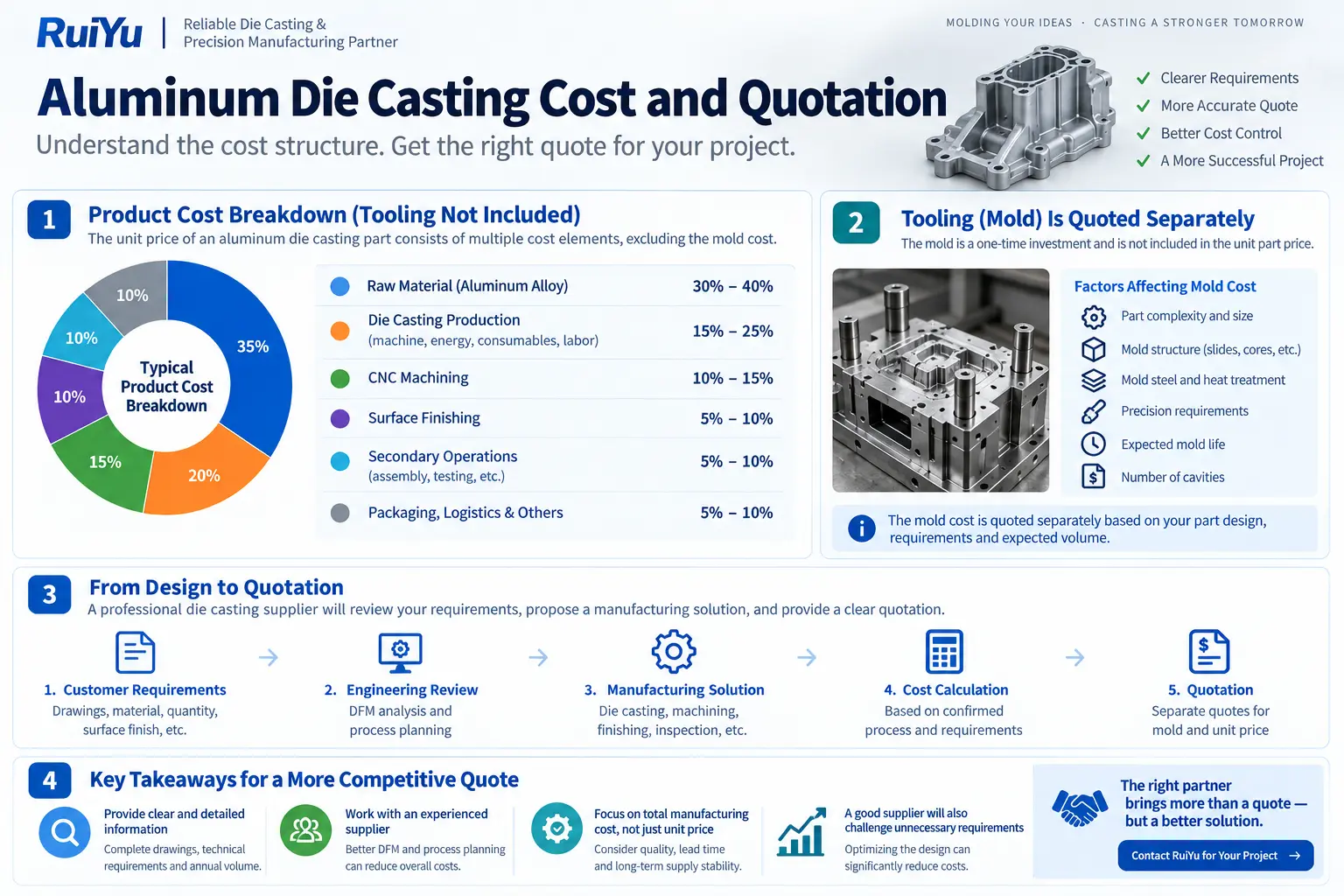
You have a 3D model, a material preference, and an estimated quantity.
Isn’t that enough to request an aluminum die casting quote?
Sometimes it is enough for a preliminary discussion.
But it may not be enough for a meaningful quotation.
The problem is not always missing documents. It is often missing manufacturing information.
A supplier may need to make assumptions about the material, critical dimensions, machining scope, surface treatment, inspection requirements, tooling, or production volume. Different assumptions can lead to different manufacturing solutions—and therefore different quotations.
A good aluminum die casting RFQ is not about providing more information than necessary.
It is about providing the information that can affect the manufacturing decision.
This die casting RFQ checklist explains what OEM buyers should provide before requesting a quotation, and why each item matters from an engineering perspective.
1. Start With the Part and Its Application
A drawing tells a supplier what the part looks like.
It does not always explain what the part needs to do.
Before requesting a quote, provide basic information about:
- Part name and function
- End application
- Mating or assembly components, where relevant
- Operating environment
- Whether the component is structural, cosmetic, pressure-tight, thermal, or primarily dimensional
- Known critical performance requirements
You do not need to disclose your entire product design or business strategy.
The supplier simply needs enough application information to understand which requirements are important.
For example, a casting used as a structural mounting component may require different engineering attention from a decorative housing.
A component used for sealing may require greater attention to internal casting quality and machined sealing surfaces.
A part exposed to an outdoor environment may also have different material and surface-treatment requirements from one used inside protected equipment.
This is why a good RFQ starts with function, not simply geometry. For more on how part requirements affect die casting feasibility, see our Die Casting Design Points.
2. Provide Both 3D CAD Data and a Controlled 2D Drawing
The 3D model and 2D drawing answer different questions.
 The 3D CAD Model Shows the Geometry
 The 3D CAD Model Shows the Geometry
The supplier can use the 3D model to review:
- Overall geometry
- Wall thickness
- Ribs and bosses
- Holes and openings
- Draft and potential undercuts
- Parting-line considerations
- General casting structure
- Areas requiring machining
STEP or another suitable neutral CAD format is often useful for supplier communication.
The 2D Drawing Defines the Requirements
The drawing should identify, where applicable:
- Critical dimensions
- Dimensional tolerances
- Datums
- Geometric tolerances
- Threads
- Surface-finish requirements
- Material specification
- Critical machined features
- Inspection requirements
- Drawing revision
A 3D model is not a substitute for a controlled 2D drawing.
The model may describe the shape accurately, but the drawing normally defines which dimensions, tolerances, and features must be controlled.
If the project is still under development and a complete 2D drawing does not exist, simply state that.
A supplier can still conduct a preliminary engineering review based on the available CAD data. The quotation should then be understood as preliminary until the remaining requirements are confirmed.
3. Define the Material: Alloy or Performance Requirement?
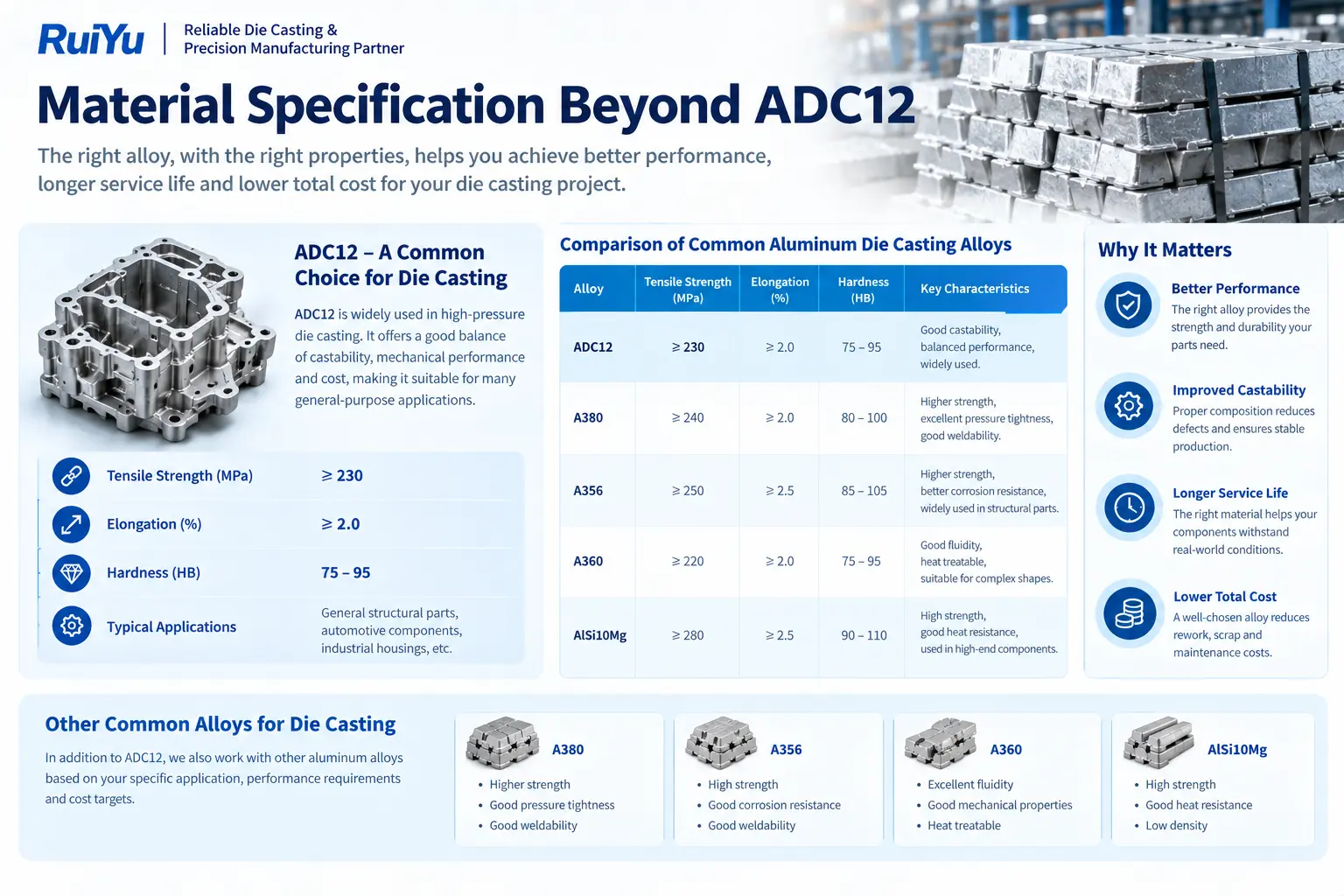
One of the most important questions in an RFQ is not simply:
“What aluminum alloy do you use?”
It is:
“What does the component need the material to achieve?”
If the alloy has already been selected, provide:
- Alloy designation
- Applicable material standard or customer specification
- Heat-treatment or temper requirements, if applicable
- Material certification requirements, if applicable
If the alloy has not been finalized, describe the performance requirements behind the material selection.
These may include:
- Mechanical performance
- Corrosion resistance
- Thermal conductivity
- Machinability
- Surface-treatment compatibility
- Weight considerations
- Application environment
A commonly used die casting alloy is not automatically the correct choice for every application.
For example, two components may both be aluminum die castings but have very different requirements because one is primarily structural while another requires corrosion resistance, thermal performance, or a particular finishing process.
The more clearly the RFQ describes the application requirements, the easier it is for the supplier to evaluate whether the proposed alloy is appropriate.
For more information on common alloys, see our Die Casting Materials Guide.
4. Give the Supplier the Production Volume, Not Just the First Order
A typical RFQ may say:
Initial order: 5,000 pcs
That is useful, but it may not tell the supplier enough about the project.
Where possible, provide:
- Prototype quantity
- Initial production quantity
- Expected annual volume
- Expected order frequency
- Expected production life
- Possible future volume changes
The reason is straightforward:
Die casting is a tooling-dependent production process.
Production volume can influence tooling strategy, production planning, equipment selection, and the economics of the finished component.
A project requiring 2,000 pieces for a one-time application is different from a project requiring 2,000 pieces initially and 50,000 pieces annually afterward.
If the annual volume is uncertain, provide a realistic estimate or range rather than creating false precision.
The supplier needs to understand not only how many parts you need now, but also what the production program may become.
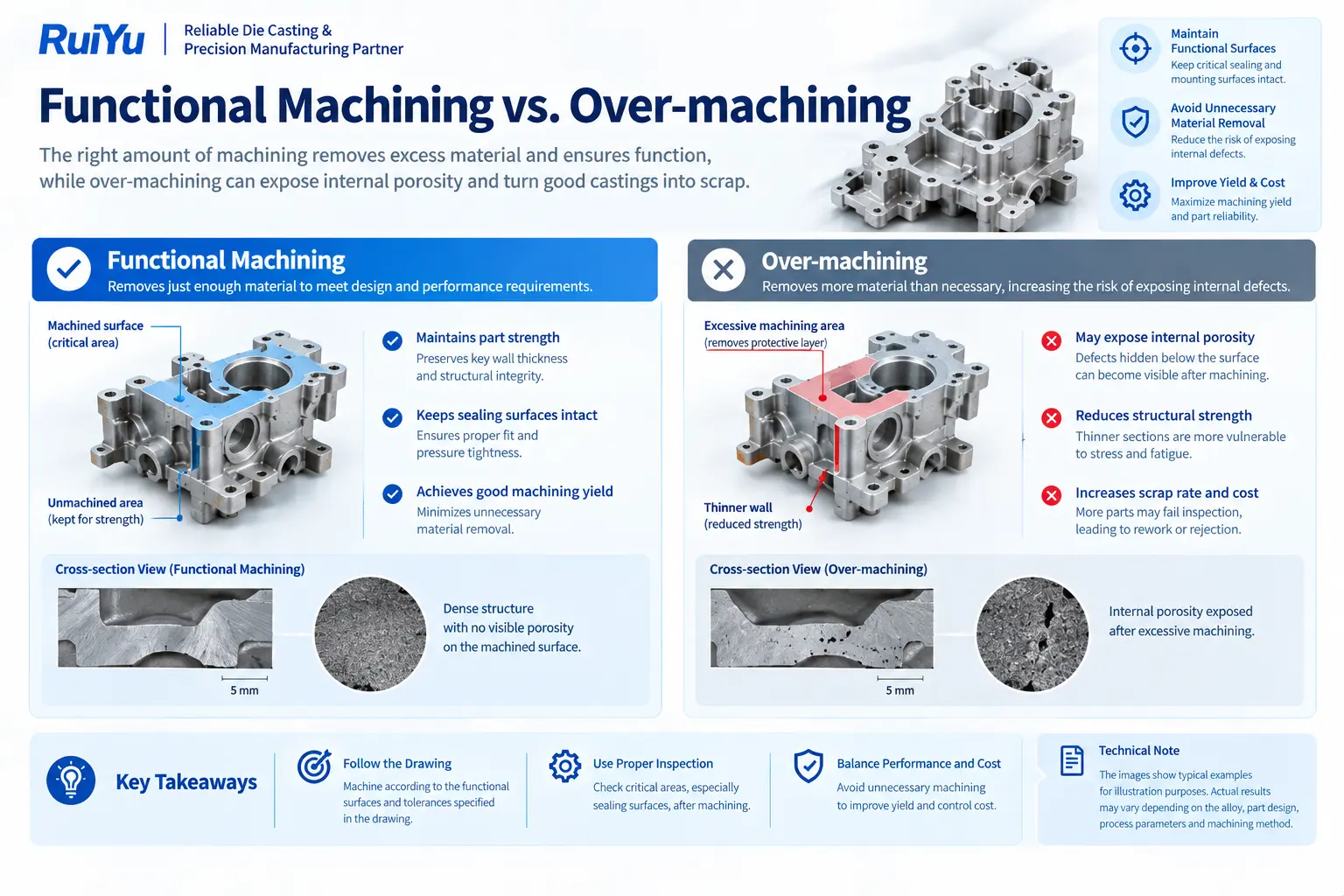
5. Define the Machining Scope: What Must Be Machined and What Can Stay As-Cast
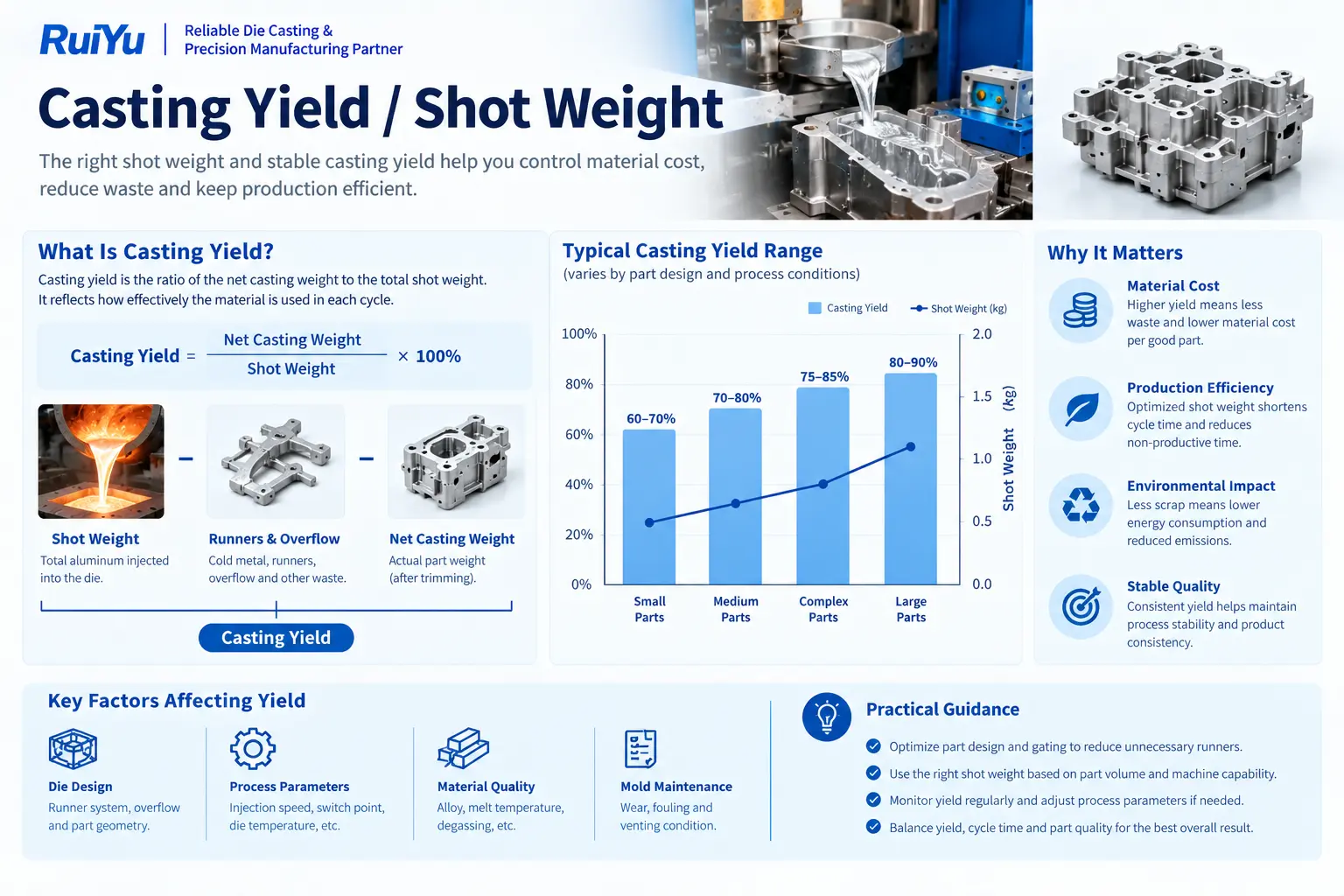
The phrase “die casting part” does not necessarily mean the same finished condition to every buyer.
Before requesting a quote, clarify whether you need:
- As-cast components
- Castings with selected machining
- Fully CNC-machined components
- Surface-treated components
- Finished and assembled components
Then identify the functional features requiring machining.
Typical examples include:
- CNC holes
- Threaded holes
- Bores
- Bearing seats
- Sealing surfaces
- Gasket faces
- Mounting surfaces
- Critical dimensional features
The RFQ should make clear which features are functionally important and therefore require machining, and which surfaces can remain as-cast.
This distinction directly affects the manufacturing process and quotation.
If a surface does not require machining for assembly, sealing, fit, or dimensional control, the RFQ should say so where appropriate.
Otherwise, different suppliers may interpret “finished part” differently.
One supplier may include machining only on critical holes and mounting surfaces.
Another may assume that much more of the component needs to be CNC machined.
A clear machining scope makes the quotations much easier to compare. Our Custom Die Casting Components service can cover die casting together with CNC machining and other secondary operations.
6. Surface Finish: Define the Requirement, Not Just the Color
Surface treatment is another area where a short RFQ can create very different interpretations.
For example:
Black finish
does not necessarily define the actual manufacturing requirement.
Depending on the application, the RFQ may need to specify:
- Surface-treatment process
- Color requirement
- Gloss or appearance requirement, if relevant
- Coating thickness, where functionally important
- Corrosion-resistance requirement
- Cosmetic acceptance criteria
- Visible surfaces
- Areas requiring masking
The important question is not simply:
What color should the part be?
It is:
What performance or appearance does the surface treatment need to provide?
A functional outdoor component may prioritize corrosion resistance.
A visible consumer product may place greater emphasis on appearance consistency.
A machined sealing component may have areas that should remain untreated or require masking.
The RFQ should make these priorities clear before quotation whenever they can affect the manufacturing process or cost. Surface treatment is also part of the broader custom die casting service scope and should be defined early when it affects the manufacturing route.
7. Define What Needs to Be Controlled
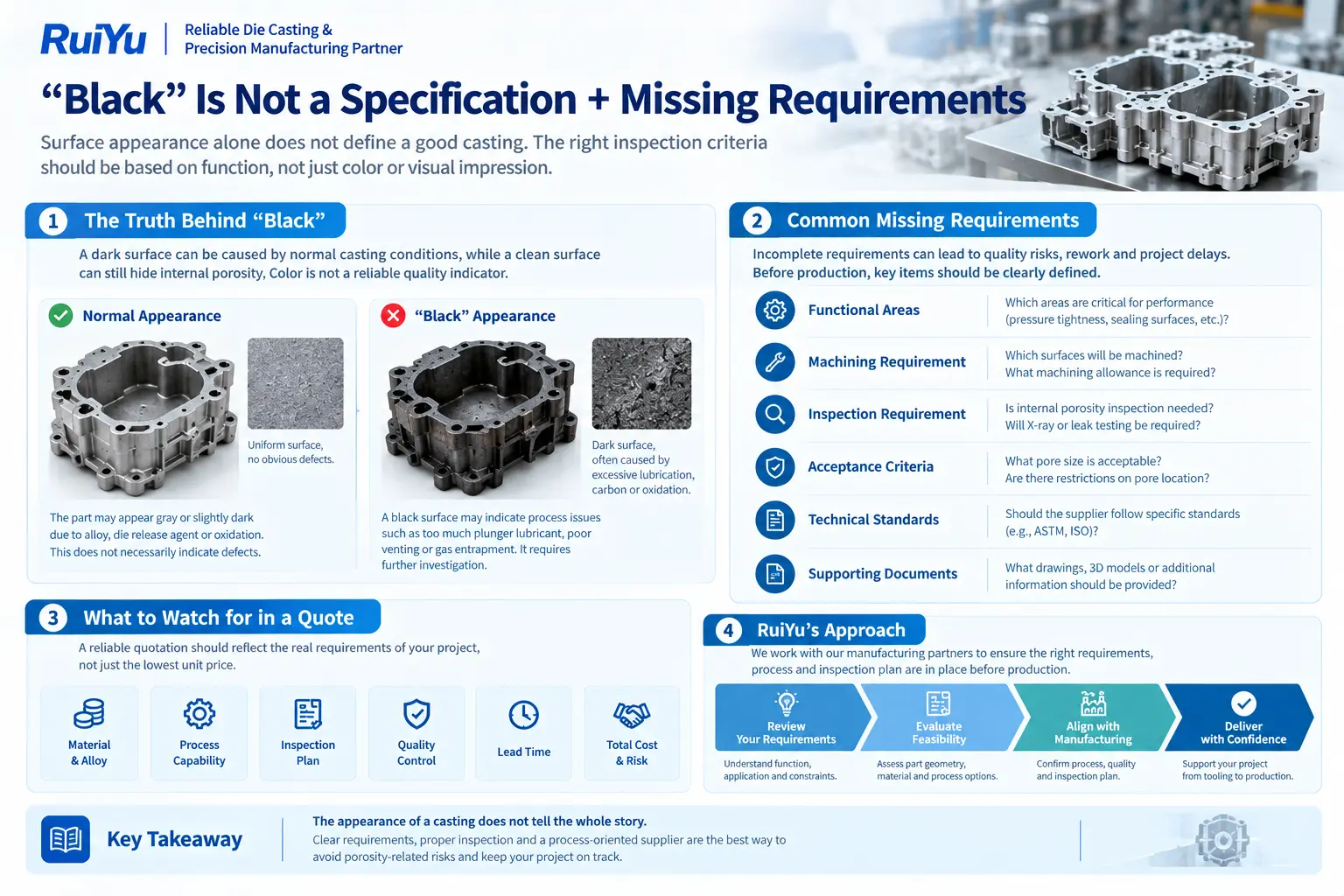
One of the weakest statements in an RFQ is:
“High quality required.”
Every serious supplier already knows that quality matters.
The more useful question is:
Which characteristics are critical, and how should they be verified?
Depending on the application, the RFQ may define requirements for several areas.
Dimensional Inspection
Identify:
- Critical dimensions
- Datums
- Tolerances
- Measurement method
- First Article Inspection (FAI)
- CMM inspection, where required
Internal Casting Quality
For critical components, the RFQ may need to identify requirements concerning:
- Porosity
- Internal defects
- Critical internal areas
- X-ray or CT inspection
- Applicable casting-quality criteria
Leak or Pressure Testing
For pressure-tight components, specify:
- Test medium
- Test pressure
- Hold time
- Allowable leakage
- Test method
Material Documentation
Where required, identify:
- Material certificates
- Alloy verification
- Traceability
- Lot identification
- Other required documentation
The principle is simple:
Tell the supplier what needs to be controlled, rather than simply saying that quality must be good.
This is particularly important for components where internal casting quality, sealing performance, or critical dimensions directly affect product function. For a deeper look at factors that can influence porosity, see our guide on How to Reduce Porosity in Aluminum Die Casting.
8. Clarify the Tooling Situation and Project Stage
Tooling information is especially important for die casting because the mold is an integral part of the manufacturing process.
First identify the project stage:
- New product development
- Prototype
- Production-ready project
- Existing production part
- Second-source project
- Existing tooling transfer
Then clarify the tooling situation:
- New die casting mold required
- Existing tooling available
- Existing mold requires modification
- Existing tooling will be transferred
- Tool ownership requirements
- Tool maintenance or storage requirements
For an existing production part, provide the current drawing revision and available production information.
For a second-source project, it can also be useful to share known manufacturing problems.
For example:
- Porosity
- Leakage
- Deformation
- Machining distortion
- Surface defects
- Tooling problems
- Unstable dimensions
The purpose is not to criticize the existing supplier. It allows the new supplier to focus the engineering review on the areas that have already caused problems. For background on how tooling decisions affect die casting projects, see our Die Cast Tooling guide.
It allows the new supplier to focus the engineering review on the areas that have already caused problems.
Known problems are often more useful than simply knowing that a part has been produced before.
9. Include Delivery, Packaging and Commercial Requirements
A manufacturing quotation also needs a defined delivery scope. The quotation should be based on a clearly defined manufacturing scope, rather than simply a unit price; see our guide on Why Aluminum Die Casting Quotes Vary for a deeper discussion of quote assumptions and engineering requirements.
Delivery
Where applicable, provide:
- Target production start
- First-article timing
- Required production delivery date
- Shipment frequency
- Destination
Packaging
Specify whether you need:
- Bulk packaging
- Individual protection
- Dividers or trays
- Export packaging
- Product labels
- Barcodes
- Customer-specific identification
Packaging can become particularly important when the component has cosmetic surfaces, machined features, or a long international transportation route.
Commercial Scope
The RFQ should also make clear:
- Delivery destination
- Preferred Incoterm, if applicable
- Whether packaging is included
- Whether special inspection or testing is included
- Whether tooling should be quoted separately
- Any other quotation-scope requirements
This helps ensure that suppliers are not comparing different commercial scopes under the same unit price.
10. The 10-Point Aluminum Die Casting RFQ Checklist
Before sending an RFQ to an aluminum die casting supplier, check whether you have covered the following:
| ItemWhat to Provide | |
|---|---|
| 1. Part & Application | Part function, application, operating environment |
| 2. 2D Drawing | Revision, dimensions, tolerances, datums, critical features |
| 3. 3D CAD | STEP, IGES, or appropriate CAD data |
| 4. Material | Alloy designation or required performance |
| 5. Volume | Prototype, initial order, annual demand, expected volume |
| 6. Machining | CNC scope, threads, bores, sealing and functional surfaces |
| 7. Surface Finish | Treatment process, color, appearance and corrosion requirements |
| 8. Quality | Inspection, FAI, internal quality, leak testing, documentation |
| 9. Tooling | New/existing tooling, ownership and project stage |
| 10. Delivery & Commercial | Schedule, packaging, destination, Incoterm and quotation scope |
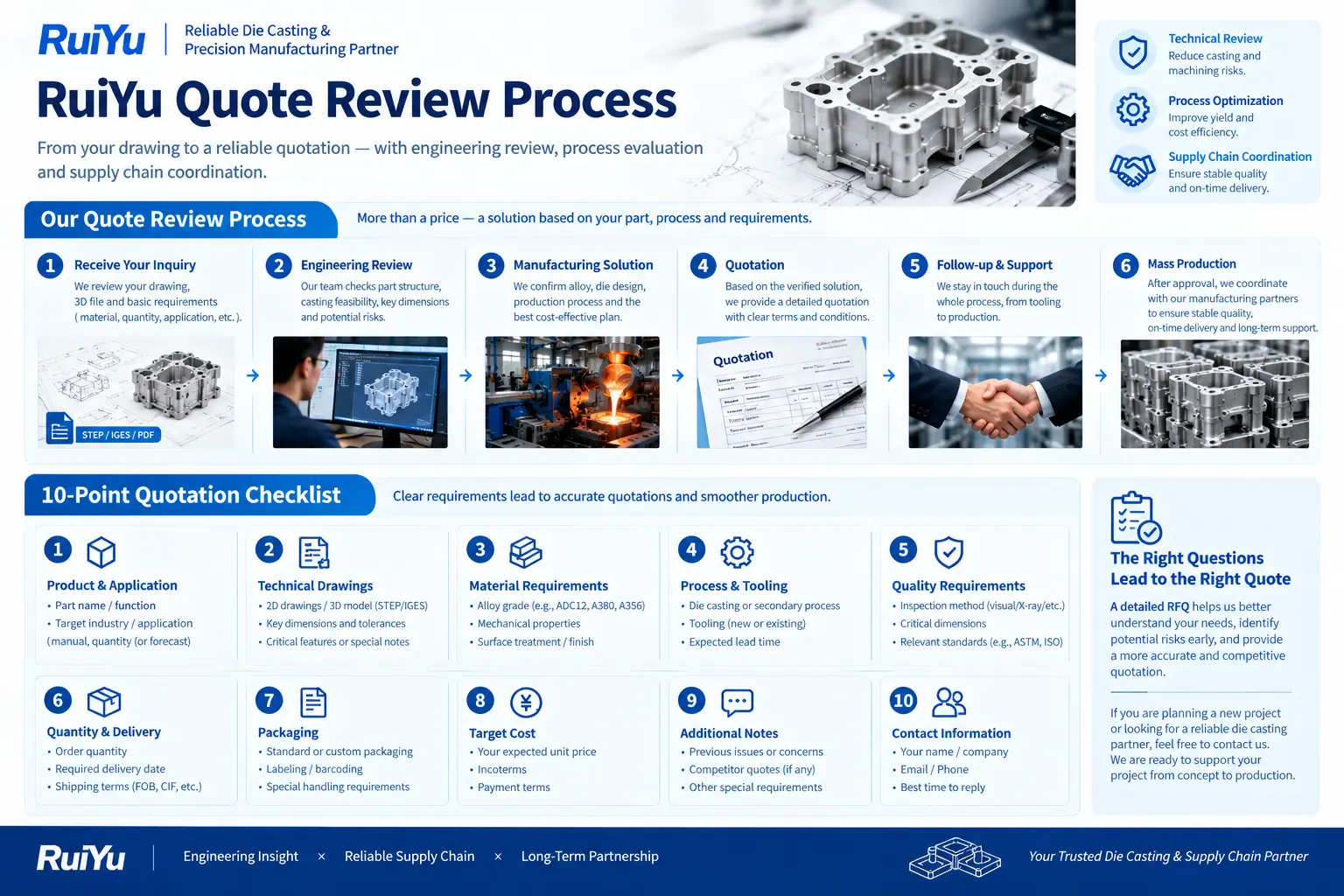 You do not need every item to be completely finalized before contacting a supplier.
The purpose of this checklist is to identify:
What is known?
**
What is missing?**
**
What assumptions will the supplier have to make?**
That is the real purpose of an RFQ checklist.
What If You Don’t Have All the Information Yet?
Not every OEM project starts with a complete RFQ package.
You may only have:
- A 3D CAD model
- A basic description of the application
- An estimated production volume
- A preferred material
- A few known critical requirements
That can still be enough for a preliminary engineering discussion.
The important thing is to be transparent about what is confirmed and what is still under development.
A supplier can review the available information, identify the missing requirements, and determine what needs to be clarified before a firm quotation can be prepared.
This is often more useful than forcing incomplete information into a seemingly complete RFQ.
A Better RFQ Creates a Better Quote
The purpose of an aluminum die casting RFQ is not to create a large package of documents.
It is to reduce the number of assumptions behind the quotation.
The most important information is the information that can change the manufacturing solution:
Part Function → Geometry → Material → Volume → Machining → Surface Finish → Quality → Tooling → Delivery
When these requirements are clearly defined, suppliers can evaluate the same project against a more consistent scope. This is the basis of an engineering-led custom die casting solution rather than a quotation based on incomplete assumptions.
The resulting quotations become easier to understand and compare.
If you are not sure whether your RFQ contains enough information, RuiYu can review the available drawings and project requirements, identify key missing information, and help define the manufacturing scope before quotation.