
Short answer: Die casting becomes cheaper than CNC machining once its lower per-part cost has paid back the one-off tooling cost. The break-even quantity is:
Break-even quantity = one-off cost ÷ (CNC all-in unit cost − die-cast all-in unit cost)
Whether that lands at a few hundred pieces or several thousand depends on tooling complexity, the unit-cost gap, how much machining the die-cast part still needs, and whether the design is frozen. Published estimates vary widely, so calculate with quotes for your own part rather than relying on a rule of thumb.
How do die casting and CNC machining differ?
CNC machining cuts a part from solid stock. There is no tooling, setup is fast, and it suits prototypes and low volumes. You pay for machine time on every part, so unit cost falls only modestly as quantity grows.
High-pressure die casting injects molten metal (typically aluminum or zinc) into a steel mold. You pay for the mold up front, and each part then costs much less to produce. The trade-offs are mold lead time (typically weeks, depending on complexity) and the cost of design changes after tooling.
How do you calculate the break-even point?
The formula above works only if both unit costs are all-in:
- One-off cost includes the tool, sample iterations, and any tool modifications after the first samples (T1).
- All-in unit cost is the piece price plus the per-piece share of everything that recurs: secondary machining, surface treatment, scrap allowance, tool maintenance, inspection, packaging and freight.
| Cost item | Enters the formula as | Notes |
| Tooling (mold) | One-off cost | Paid up front |
| T1 samples and tool modifications | One-off cost | Depends on how mature the DFM review was |
| Piece price | All-in unit cost | From the quote |
| Secondary machining | All-in unit cost | Often needed on threads, sealing faces and tight bores |
| Surface treatment | All-in unit cost | Results differ by alloy |
| Scrap and rework | All-in unit cost | An allowance that varies by part |
| Tool maintenance | All-in unit cost | Spread over the production run |
| Inspection, packaging, freight and duties | All-in unit cost | Depends on route; check current rates |
A worked example
Hypothetical example, not RuiYu project data: a single-cavity tool at $8,000, a die-cast all-in unit cost of $4, and a CNC all-in unit cost of $25. Real values depend on geometry, alloy, cavity count and finish.
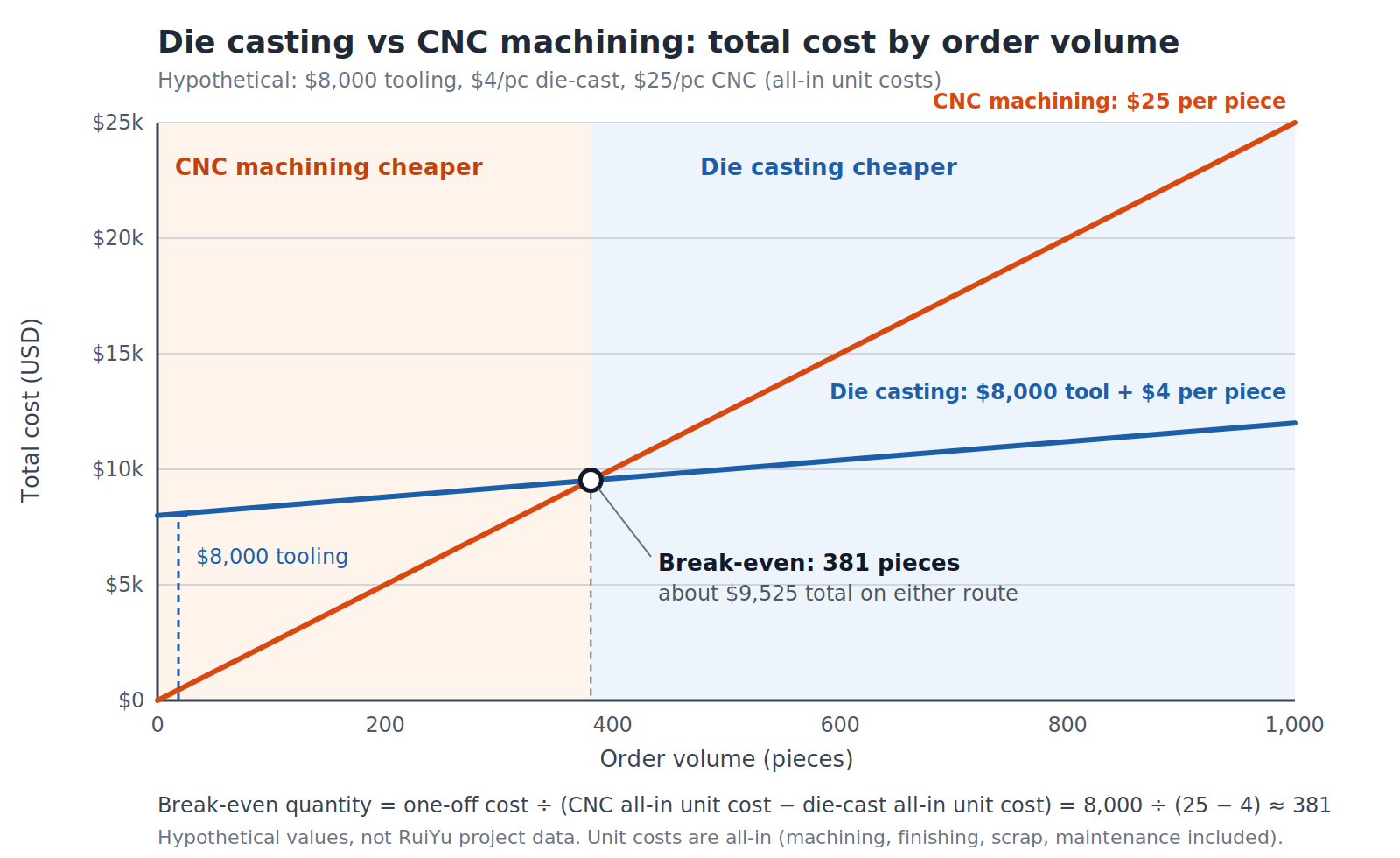
| Order volume | CNC machining | Die casting ($8,000 tool + $4/pc) |
| 50 pcs | $1,250 | $8,200 |
| 200 pcs | $5,000 | $8,800 |
| 381 pcs | $9,525 | $9,524 ← break-even |
| 500 pcs | $12,500 | $10,000 |
| 1,000 pcs | $25,000 | $12,000 |
| 10,000 pcs | $250,000 | $48,000 |
How much does tooling cost move the break-even?
The same formula with four hypothetical tooling costs and the same unit costs ($25 CNC, $4 die-cast, a gap of $21):
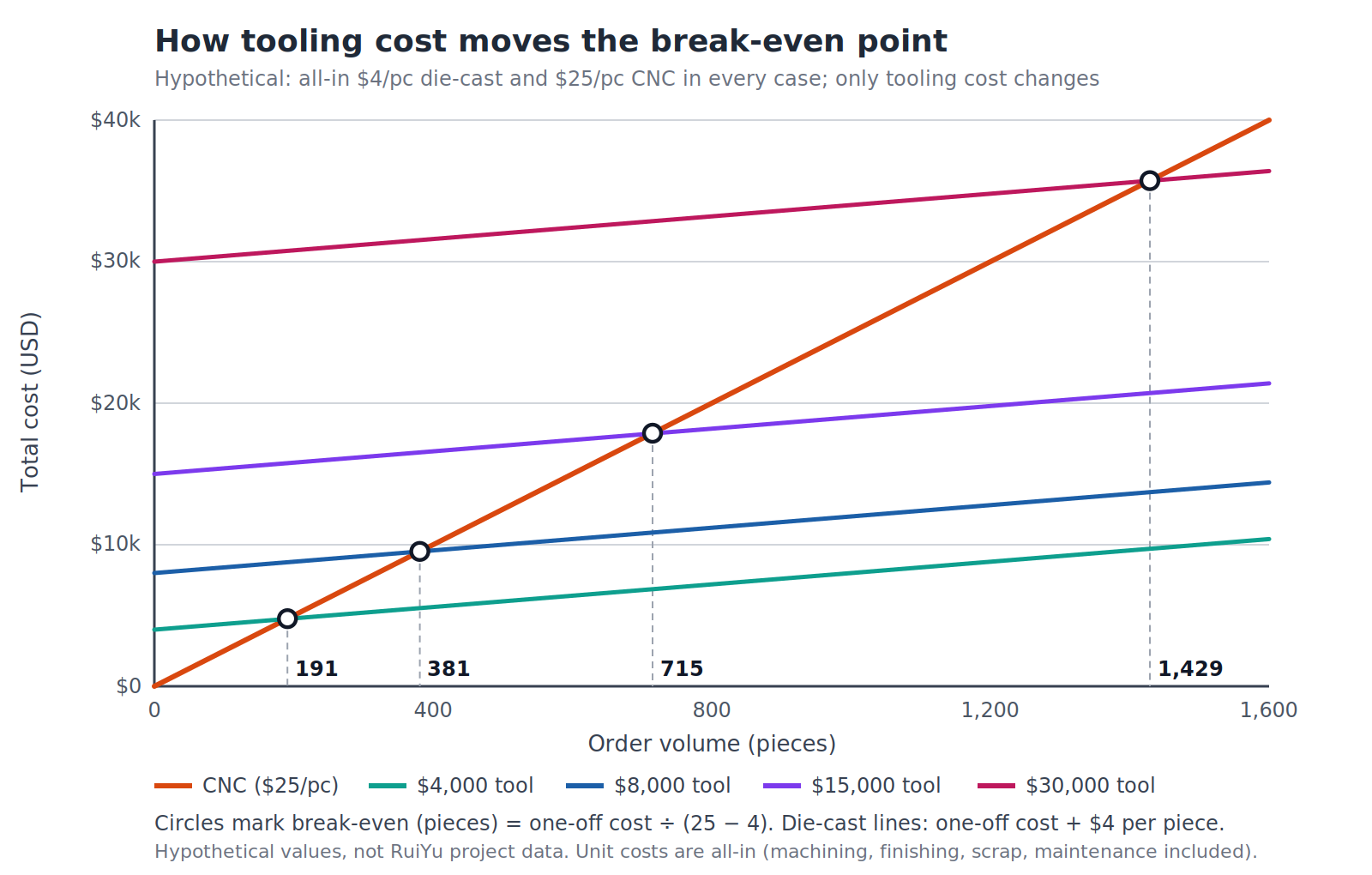
| Tooling cost | Gap $10/pc | Gap $21/pc | Gap $40/pc |
| $4,000 | 400 pcs | 191 pcs | 100 pcs |
| $8,000 | 800 pcs | 381 pcs | 200 pcs |
| $15,000 | 1,500 pcs | 715 pcs | 375 pcs |
| $30,000 | 3,000 pcs | 1,429 pcs | 750 pcs |
Gap = CNC all-in unit cost minus die-cast all-in unit cost.
Three hypothetical scenarios
| Scenario | One-off cost | CNC all-in | Die-cast all-in | Break-even |
| A: simple housing, light finishing | $8,000 | $25 | $7 | 445 pcs |
| B: complex part with slides | $30,000 | $60 | $18 | 715 pcs |
| C: most features still need machining | $12,000 | $30 | $24 | 2,000 pcs |
Hypothetical inputs for illustration, not RuiYu projects. Scenario C shows why a die-cast part that still needs heavy machining pushes break-even far out.
What moves the break-even point?
- The unit-cost gap. The wider the gap, the earlier die casting wins.
- Tooling complexity. Sliders, deep cores and tight tolerances raise tooling cost and push break-even out.
- Secondary machining. Every feature that must still be machined after casting narrows the gap.
- Design stability. If the design will change, early tooling spend is at risk. Freeze the design first.
Is a die-cast part the same material as a CNC prototype?
No. CNC prototypes are commonly cut from wrought alloys such as 6061 (Aluminum Association designation system), while die casting uses casting alloys such as A380 (ASTM B85/B85M designation system) or ADC12 (JIS). [SOURCE NEEDED: verify the current JIS standard for ADC12] They are not interchangeable: strength, elongation, corrosion behavior and cosmetic anodizing results can differ, and die-cast parts can contain porosity that matters for pressure-tight or cosmetic parts. [SOURCE NEEDED: NADCA or equivalent for porosity and property differences] Confirm that the die-casting alloy meets your functional requirements before committing to tooling.
How do aluminum and zinc die casting compare?
The examples here assume aluminum. Zinc is also widely die cast, but its cost curve differs. Zinc is typically cast in hot-chamber machines, while many aluminum alloys, including A380, are cast in cold-chamber machines (ASTM B85/B85M). Tooling cost, unit cost and achievable wall thickness differ between the two, so ask for separate quotes if either alloy could work. [SOURCE NEEDED: NADCA or equivalent for zinc process and tooling differences]
Rules of thumb by volume
General starting points, not RuiYu data. Verify with quotes.
| Volume | Starting point | Preconditions for die casting | Does not apply when |
| ~100 pcs | CNC machining | Design frozen, die-casting-friendly geometry, confirmed repeat demand | Design may still change, or tight tolerances are needed across most features |
| ~500 pcs | Quote both routes | A simplified or prototype tool is acceptable; secondary machining is modest | Complex slides or cores push tooling cost above the saving |
| ~1,000 pcs | Die casting is often competitive | Stable design, moderate tooling complexity | Most features still need machining, or the geometry is hard to cast |
| 10,000+ pcs | Die casting in most cases | Castable geometry; tolerances achievable with limited machining | Geometry cannot be cast, or demand is uncertain |
What is the usual path from CNC prototype to die casting?
- CNC prototypes validate fit and function.
- DFM review (design for manufacturability) adapts the part for casting: draft angles, uniform wall thickness, fillet radii and machining allowances.
- Tooling is built.
- T1 samples (first samples from the new tool) are inspected and approved.
- Volume production begins.
A part designed for CNC rarely transfers to die casting unchanged, so skipping the DFM review risks costly tool modifications. See what to know before committing to die casting tooling and how alloys and die casting types compare.
Can you die cast only 500 pieces?
Sometimes. Some suppliers set minimum order quantities because production tooling economics may not fit their machine schedule. Options include a simplified single-cavity tool, prototype or bridge tooling (a lower-cost tool used before production tooling; definitions vary by supplier), or placing the job with a manufacturing partner whose equipment fits the volume. RuiYu coordinates die casting through qualified manufacturing partners in Ningbo, and reviews low-volume projects case by case, including recommending CNC when it is the better route.
What matters beyond unit cost?
- Tool life and amortization. Tool life depends on alloy, geometry and maintenance. Ask the supplier how many shots the tool is expected to deliver and what maintenance is included.
- Tool ownership and cash flow. Tooling is paid up front, while CNC cost arrives gradually with each order. Confirm who owns the tool.
- MOQ and lead time. These vary by supplier and part. Confirm them in the quote.
- Forecast and inventory risk. A high tooling spend assumes the volume actually arrives.
- Logistics and duties. These depend on the route and current rates, so check them for your own shipment.
What should you send with an RFQ?
- 3D model (STEP) and a 2D drawing marking critical tolerances
- Material and finish requirements
- First-order quantity and expected annual volume
- Design status: frozen, or still changing
- Operating environment (outdoor exposure, corrosion, pressure tightness)
- Target delivery date
Before quoting, RuiYu clarifies the application and questions requirements that add cost without adding function, so the quote matches the actual manufacturing scope.
FAQ
At what quantity is die casting cheaper than CNC machining?
When the one-off cost divided by the all-in unit-cost gap is less than your order quantity. It can be a few hundred pieces for a simple part or several thousand for a complex one.
Can a CNC-machined part be die cast without redesign? Rarely. Draft angles, wall thickness, fillets and undercuts usually need DFM changes first, and the alloy changes from a wrought grade to a casting grade.
Does a die-cast part still need machining? Often, on critical features such as threads, sealing faces and tight-tolerance holes, depending on the tolerance requirement. That machining belongs in the die-cast all-in unit cost.
How long does die casting tooling take? Typically weeks rather than days, depending on complexity. Ask your supplier for a schedule specific to your part.
Is die casting or CNC better for a design that may still change? CNC, usually. Tooling changes after the mold is cut are costly, so freeze the design before committing to a tool.
References
- ASTM B85/B85M-25, Standard Specification for Aluminum-Alloy Die Castings, ASTM International. [OWNER/EDITOR: re-check that this is still the current version on the publish date]
- [SOURCE NEEDED: NADCA publication(s) for porosity, properties and zinc vs aluminum]
- [SOURCE NEEDED: JIS standard for ADC12, if the designation stays in the article]
Get a quote
Send your 3D model and target volume for an engineering review and a quote on the route that fits.
