
Introduction
For trailer distributors, RV accessory brands, and commercial fleet buyers, stocking the right locking hardware is often more confusing than it should be. Stock the wrong type, and your clients face theft or installation frustration. Stock poor quality, and you eat the return shipping costs.
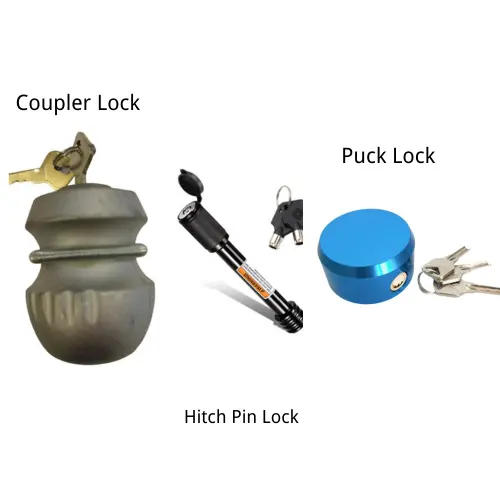
The three most common security devices—Trailer Coupler Locks, Hitch Pin Locks, and Puck Locks—serve fundamentally different purposes. One prevents unhitched trailers from being towed away. One secures active towing connections. And one—when used alone—protects cargo doors and storage compartments, or when paired with a heavy-duty cast iron housing, becomes an ultra-secure coupler lock solution.
Understanding these distinctions—and the manufacturing details behind each—is the difference between a profitable accessory line and a returns headache.
Quick Comparison: Which Lock Does What?
| Lock Type | Core Security Function | Typical Applications | Key Sourcing Considerations |
|---|---|---|---|
| Trailer Coupler Lock | Prevents unauthorized hookup when trailer is unhitched and parked. | RV trailers, boat trailers, utility trailers at storage lots. | Coupler size compatibility, corrosion resistance, visible deterrence. |
| Hitch Pin Lock | Secures the ball mount / shank inside the receiver while towing. | Tow vehicles, bike racks, cargo carriers, 5th-wheel hitches. | Pin diameter (5/8″ vs 1/2″), groove machining accuracy, rubber dust cap. |
| Puck Lock | Provides high-security core locking—used alone for doors/gates, or embedded in cast iron housings for coupler protection. | Cargo doors, van rear gates, toolboxes, heavy hasps, or paired with coupler shrouds for premium RV security. | Fully shrouded shackle design, cylinder anti-drill protection, body hardness, housing material thickness. |
A coupler lock is designed exclusively for when the trailer is disconnected from the tow vehicle and left unattended. It blocks the coupler’s latch mechanism or fills the cavity, preventing a thief from dropping it onto their own hitch ball.
Application Scenarios:
Long-term storage lots
Overnight RV camping (unhitched)
Jobsite utility trailers
Manufacturing Focus:
As a die-casting OEM, we recommend buyers prioritize housing geometry and coating stability over sheer weight. Zinc alloy die-casting allows for complex, tight-tolerance shrouds that resist crowbar prying. Surface treatment (e-coating or powder coating) should be validated through salt spray testing according to the required application environment.
👉 Need deeper selection criteria? Read our dedicated guide: How to Choose the Right Trailer Coupler Lock (2026 Buyer’s Guide).
Unlike a coupler lock, a hitch pin lock is used while towing. It replaces the standard hairpin cotter to lock the ball mount shank securely inside the hitch receiver tube. Without it, a thief can simply pull the pin and detach your cargo in seconds.
Application Scenarios:
Daily tow vehicles
Hitch-mounted bike racks and cargo trays
Heavy-duty commercial towing (Class III/IV/V)
Sizing & Machining Precision:
5/8″ diameter for standard Class III/IV receivers
1/2″ diameter for Class I/II light-duty receivers
Critically, the groove positioning on the pin shank must be CNC-machined to tight tolerances. If the groove is even 1mm off, the lock won’t snap closed properly—a common failure in low-cost imports. Also, insist on a tight-fitting rubber dust cap over the cylinder; this simple protection feature significantly reduces corrosion-related cylinder failures in outdoor applications.
A puck lock (or hockey puck lock) is defined by its fully concealed shackle design. This gives it exceptional resistance to bolt cutters and pry bars, making it a high-security core component used in two primary ways:
Application 1: Secondary Access Point Security
When used alone, it’s ideal for securing cargo doors, rear gates, storage compartments, and heavy hasps. Its flat, low-profile design and lack of exposed shackle make it a favorite for commercial vans and enclosed trailers.
Application 2: High-Security Trailer Coupler Lock (Critical Application)
This is where the puck lock truly shines in the trailer security world. When paired with a heavy-duty cast iron or welded steel lock housing (shroud) that fully encases the trailer coupler, the puck lock transforms into an ultra-secure coupler lock.
How it works: The steel/cast iron housing covers the entire trailer coupler. The puck lock is integrated into this housing, locking the two halves together and completely sealing the coupler inside.
Why it’s superior: This combination defeats almost all conventional attacks. The heavy-gauge steel housing resists prying and hammering, while the puck lock’s concealed shackle prevents cutting. It’s a premium solution for protecting expensive RV trailers, commercial fleets, and high-theft areas.
Manufacturing QC Check:
When sourcing puck locks for any application, verify cylinder smoothness and corrosion resistance. However, for coupler lock applications, the material and wall thickness of the cast iron/steel housing are equally critical. Also, ensure the lock’s dimensions are compatible with standard hasp surrounds used in these housing designs.
To simplify purchasing decisions for your clients, use this rule of thumb:
| Customer Need | Recommended Lock Type |
|---|---|
| “My RV is parked in a storage lot for winter.” | Coupler Lock (shrouded type) |
| “I tow my boat every weekend.” | Hitch Pin Lock (with rubber cap) |
| “I store expensive tools in my cargo trailer.” | Puck Lock (for rear door) |
| “I want maximum protection for my premium RV.” | Cast Iron Housing + Puck Lock (ultimate solution) |
When evaluating suppliers for any of these three lock types, experienced procurement professionals focus on these hidden factory variables:
A. Housing Integrity (Porosity Control)
Die-cast zinc alloy or aluminum housings must have optimized wall thickness and rib structures. Poor mold design creates micro-porosity, which reduces impact strength—meaning the lock cracks under a heavy hammer strike. Always ask about the mold flow analysis (DFM) stage.
B. Surface Treatment Consistency
Outdoor locks are exposed to UV, rain, and road salt. Insist on:
E-coating or powder coating (not just cheap spray paint)
Documented salt spray test reports (validated for your required application environment)
C. Cylinder & Key Management
For commercial fleets, Keyed Alike (KA) is often a must-have to simplify fleet operations. For retail, Keyed Different (KD) ensures each customer gets a unique combination. Your supplier must offer flexible cylinder assembly to support both.
D. Batch-to-Batch Consistency
The 1,000th unit must be identical to the 1st sample. This requires:
Fixed die-casting process parameters
Regular mold maintenance schedules
100% gauge inspection on critical pin diameters
Unlike pure trading companies that source finished products from various suppliers, RuiYu integrates die-casting engineering knowledge with trailer security product development. This allows us to participate not only in product supply, but also in:
Material selection and verification
Structural optimization for manufacturability
Tooling design and improvement
Manufacturing quality control throughout production
This engineering-led approach means we can identify potential failure points before mass production—not after your customers start complaining.
Securing a trailer isn’t about picking the “strongest” lock—it’s about picking the right lock for the right point of vulnerability. Coupler locks stop towing theft. Hitch pin locks secure the active connection. Puck locks guard cargo—or, when combined with cast iron housings, deliver premium coupler protection.
For distributors and OEM brands, the real value lies in partnering with a manufacturer who controls material stability, machining precision, and coating performance from mold to mass production.
Yes. Most commercial trailer lock systems support both configurations. Keyed Alike (KA) allows a fleet owner to open multiple locks with a single key, while Keyed Different (KD) ensures each lock has a unique combination, which is essential for retail markets.
Zinc and aluminum alloys are widely used for lock housings because they offer good casting performance, dimensional stability, and can achieve reliable corrosion protection through appropriate surface treatments. For internal pins and high-stress components, hardened steel is typically utilized.
Yes. OEM buyers can collaborate with manufacturers to customize the housing geometry, mold logos, select specific cylinder mechanisms, and design tailored retail or industrial packaging.
Distributors should prioritize production consistency, material certifications, weatherproofing features (such as cylinder caps), and the manufacturer’s ability to scale production while maintaining tight machining tolerances.
At RuiYu (Ningbo RuiYu Metal Products), we combine 20+ years of precision die-casting experience with rigorous in-house QC to deliver trailer security hardware that survives real-world conditions.
What we offer for B2B partners:
🧪 Free sample evaluation – Test our salt-spray resistance and fit tolerances yourself.
🖊️ OEM/ODM customization – Send your CAD drawings or target dimensions; our engineering team provides DFM feedback within 48 hours.
📦 Mixed SKU container consolidation – Order coupler locks, hitch pins, and puck locks together to save shipping costs.
👇 Two ways to start: