
A Practical Guide for OEM Buyers to Improve Tooling Reliability and Reduce Production Risks
Key Takeaways
- Die casting mold life directly affects production cost, delivery reliability, and long-term manufacturing efficiency.
- Premature tooling failure is often caused by design, material selection, thermal stress, or process issues rather than mold steel itself.
- H13 and 8407 are widely used hot work steels for aluminum die casting tooling, with different performance advantages.
- Regular stress relief treatment and preventive maintenance help reduce tooling risks and extend mold service life.
- Reliable tooling performance starts before mold manufacturing through proper engineering review and process planning.
Introduction: Why Die Casting Mold Life Matters for OEM Die Casting Projects
For OEM manufacturers using aluminum die casting, tooling represents one of the most important investments before mass production begins.
However, the true cost of a die casting mold is not only the initial tooling price.
A mold that fails earlier than expected can create much higher costs through:
- Production downtime
- Emergency repairs
- Unstable part quality
- Delayed customer delivery
- Increased manufacturing cost per part
In practical production, extending die casting mold life is not achieved simply by selecting a more expensive mold material.
Tooling performance depends on a combination of factors:
- Mold design
- Tool steel selection
- Heat treatment quality
- Casting process stability
- Regular maintenance
A reliable die casting tooling solution should be evaluated from the beginning of product development, not after production problems appear.
1. Mold Design Optimization: The Foundation of Longer Die Casting Mold Life
One of the most common causes of premature die casting mold failure is thermal fatigue cracking.
During aluminum die casting production, the mold surface experiences thousands of repeated thermal cycles:
- Rapid heating from molten aluminum
- Cooling during solidification
- High injection pressure
- Continuous opening and closing cycles
Over time, these repeated stresses may cause:
- Heat checking
- Cracks near gates
- Surface erosion
- Local deformation
Common Design Factors Affecting Mold Life
Reduce Stress Concentration
Complex geometries, sharp corners, and uneven wall thickness can create concentrated stress areas.
Optimized part and mold design helps improve:
- Thermal balance
- Metal flow
- Stress distribution
Optimize Gating and Cooling Design
The gating system directly affects molten metal flow behavior.
Poor gate design may cause:
- Excessive metal impact
- Local overheating
- Accelerated erosion
An effective cooling layout helps maintain stable mold temperatures and reduce thermal fatigue.
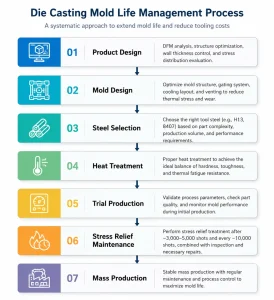
For complex OEM components, die casting mold development should include DFM review and process evaluation before tooling production.

Design Tip: Minimize Mold Modifications and Welding Repairs
Product structural changes after tool build often require welding modifications. Welding creates intense localized thermal stress and alters the material properties around the weld zone, which can severely reduce fatigue resistance and cause premature heat checking. A thorough DFM review before manufacturing is essential to freeze the product design and avoid costly welding modifications later.
2. Select the Right Mold Steel Based on Production Requirements
Choosing mold steel is a balance between tooling investment and expected production performance.
During aluminum die casting, molds must withstand:
- High temperature exposure
- Thermal cycling
- Mechanical impact
- Wear during repeated production
Hot work tool steels such as H13 and 8407 are widely used because of their excellent toughness and thermal fatigue resistance.
H13 vs 8407 Die Casting Tool Steel Comparison
| Mold Steel | Key Advantages | Suitable Applications | Typical Tool Life* |
|---|---|---|---|
| H13 Tool Steel | Good toughness, thermal fatigue resistance, cost-effective performance | Standard aluminum die casting projects | Around 50,000+ shots |
| 8407 Tool Steel | Higher toughness and improved resistance to thermal cracking | Higher-volume production or demanding components | Around 80,000–100,000 shots |
*Actual mold life depends on part design, alloy type, tooling structure, production parameters, and maintenance.
Is More Expensive Steel Always Better?
Not necessarily.
A higher-grade material may increase tooling cost, but the decision should consider:
- Expected production quantity
- Part complexity
- Maintenance requirements
- Total cost per part
For some medium-volume projects, H13 may provide an excellent balance between cost and performance.
For higher-volume production requiring longer tooling stability, 8407 may provide better long-term value.
The best tooling solution is the one that matches actual production requirements.
3. Improve Tooling Durability Through Proper Heat Treatment
Even high-quality mold steel cannot perform well without proper heat treatment.
Heat treatment affects the balance between:
- Hardness
- Toughness
- Wear resistance
- Thermal fatigue performance
Why Heat Treatment Quality Matters
A die casting mold needs enough hardness to resist wear, but also enough toughness to withstand repeated thermal shock.
Incorrect heat treatment may lead to:
- Early cracking
- Reduced service life
- Surface damage
- Unstable production performance
Professional vacuum heat treatment and tempering processes help create a more reliable mold structure for repeated die casting cycles.
4. Control Casting Conditions to Reduce Thermal Stress
A well-designed mold can still experience shortened life if production conditions are unstable.
Process control plays an important role in reducing unnecessary stress on tooling.
Maintain Stable Mold Temperature
Large temperature fluctuations accelerate thermal fatigue.
Stable thermal management helps reduce:
- Heat checking
- Cracking
- Surface deterioration
Actual mold temperature requirements depend on:
- Aluminum alloy type
- Part geometry
- Cycle time
- Cooling system design
Optimize Lubrication and Cooling
Proper lubrication helps reduce:
- Friction
- Sticking problems
- Surface wear
A balanced cooling system helps maintain consistent production conditions and improves tooling stability.
5. Extend Die Casting Mold Life Through Stress Relief and Preventive Maintenance
Even a well-designed and properly manufactured mold requires regular maintenance to maintain stable production performance.
During aluminum die casting production, mold inserts experience repeated:
- Thermal expansion and contraction
- Injection pressure
- Mechanical stress
- Temperature cycling
Over time, residual stress may accumulate inside the mold steel.
If this stress is not properly managed, it may contribute to:
- Micro-cracking
- Dimensional instability
- Reduced die casting mold life
Regular Stress Relief Treatment for Die Casting Inserts
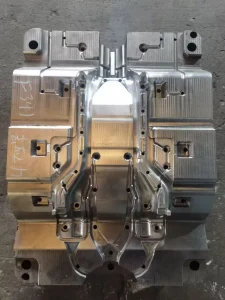
For high-value die casting tooling, periodic stress relief treatment is a common practice to release accumulated internal stress and improve mold stability.
A typical production approach may include:
- After initial production of approximately 3,000–5,000 shots, the mold core may be removed for stress relief treatment and inspection.
- During stable mass production, further stress relief maintenance may be considered at intervals of around 10,000 shots, depending on mold condition, steel grade, part complexity, and production requirements.
This process helps:
- Reduce residual stress inside mold inserts
- Minimize thermal fatigue cracking risk
- Maintain dimensional accuracy
- Extend overall tooling service life
Regular Mold Inspection and Maintenance
Stress relief treatment should be combined with regular inspection.
Critical areas include:
- Parting lines
- Inserts
- Slides
- Gate areas
- Cooling channels
Engineers also monitor:
- Crack development
- Surface wear
- Product dimensional changes
- Casting quality stability
Repair Problems Before They Affect Production
Small tooling issues can become major production problems if ignored.
Examples include:
- Minor surface cracks
- Local wear
- Damaged inserts
- Cooling performance changes
A proactive maintenance approach is usually more cost-effective than waiting for unexpected mold failure.
Why Some Die Casting Molds Fail Earlier Than Expected
Even molds using the same steel grade can have significantly different service lives.
Common reasons include:
| Failure Issue | Possible Cause |
|---|---|
| Heat cracks | Thermal fatigue, unstable cooling, excessive temperature cycling |
| Flashing defects | Parting line wear or insufficient maintenance |
| Short tooling life | Incorrect steel selection, poor heat treatment, excessive stress |
| Dimensional instability | Residual stress or mold deformation |
This is why improving mold life requires cooperation between product design, tooling development, and production management.
Practical Example: Matching Tooling Solution With Production Requirements
A simple aluminum bracket mold and a complex thin-wall housing mold may require completely different tooling strategies.
Factors affecting mold life include:
- Product geometry
- Wall thickness distribution
- Injection parameters
- Cooling design
- Production cycle time
- Maintenance schedule
The best tooling solution is not always the most expensive one.
It is the solution that provides the best balance between:
- Tooling investment
- Production reliability
- Part cost
- Expected service life
How RuiYu Supports Reliable Die Casting Tooling Solutions
Extending die casting mold life requires coordination between engineering, tooling, and production teams.
RuiYu supports OEM projects through integrated aluminum die casting services, including:
Engineering and Tooling Development
- Product design review
- DFM analysis
- Mold structure optimization
- Material recommendation
- Manufacturing feasibility evaluation
Manufacturing Support
- Aluminum die casting
- Zinc alloy die casting
- CNC machining
- Surface finishing
- Assembly solutions
By considering tooling performance from the beginning of product development, potential production risks can be reduced before mass production.
Frequently Asked Questions
Q: How long does a die casting mold last?A: Die casting mold life depends on mold material, part complexity, alloy type, production conditions, and maintenance. For aluminum die casting, properly designed tooling typically achieves tens of thousands to over 100,000 cycles.Q: Is H13 good for aluminum die casting molds?
A: Yes. H13 is one of the most commonly used hot work steels for aluminum die casting molds because it provides a good balance of toughness, thermal fatigue resistance, and cost efficiency.
Q: Is 8407 better than H13 for die casting tooling?
A: 8407 generally provides higher toughness and improved resistance to thermal cracking compared with standard H13. It is often selected for higher-volume production or applications where tooling stability is critical.
Q: How often should die casting molds be maintained?
A: Maintenance frequency depends on mold design, production conditions, and part complexity. In many production environments, stress relief treatment and inspection may be considered after initial production runs and periodically during mass production to reduce residual stress and maintain tooling stability.
Q: What causes premature die casting mold failure?
A: Common causes include poor mold design, incorrect material selection, improper heat treatment, unstable casting conditions, and insufficient maintenance.
Need Reliable Die Casting Tooling for Your OEM Project?
Choosing the right tooling strategy can significantly reduce production risks and long-term manufacturing costs.
RuiYu helps OEM customers develop reliable die casting solutions through engineering support, tooling optimization, and manufacturing coordination.
Have a new die casting project or an existing tooling challenge?
Send your CAD drawings or project requirements to RuiYu engineering team for evaluation.
