
For OEM buyers sourcing aluminum die castings from China, the cost per unit decides whether a project is viable. But the unit cost of a die-cast part is not the price of aluminum multiplied by the part’s weight. It also depends on scrap, machine time, machining, surface finishing, inspection and order quantity.
Quick answer:
Cost per unit = material + die casting + setup and trial + trimming + CNC machining + surface finishing + inspection and packaging
Tooling is normally quoted separately and can then be spread over the planned quantity. The rest of this guide shows each item with one example part, and explains where quotations most often leave things out.
All numbers below are assumptions for illustration. They are not current market prices and not a RuiYu quotation. Replace them with your own figures when you estimate a project.
1. What Is Die Casting Cost per Unit?
It is the cost, or the quoted price, of one finished die-cast part. Depending on what the quotation covers, it may include:
- Aluminum alloy
- Die casting machine time
- Trimming, deburring and straightening
- CNC machining, drilling and tapping
- Surface finishing, such as shot blasting, e-coating (KTL), powder coating or painting
- Inspection and packaging
Not every part needs all of these. A simple housing may need only trimming and a basic check. A precision part may need several machining operations and a specified finish.
The first step is to define exactly what “finished part” means. For a fair comparison, every supplier should quote the same drawing revision, alloy, quantity, machining, surface treatment and quality requirements.
2. Cost Versus Quoted Price
Cost is what it takes to make the part. The quoted price is what you are asked to pay, and it may also include supplier margin, export packaging, and delivery terms. Before comparing two quotations, check:
- Is the price for the raw casting, the machined part, or the fully finished part?
- Is export packaging included?
- Which trade term applies (for example EXW or FOB), and what is covered up to that point?
- Is tooling included, or quoted separately?
Two prices that look different are often not describing the same thing.
3. The Basic Formula
Die casting cost per unit = Material + Die casting + Setup and trial + Trimming + CNC machining + Surface finishing + Inspection and packaging
| Cost item | Main drivers |
|---|---|
| Material | Alloy price, metal consumption per accepted part, recovery of runners and scrap |
| Die casting | Machine hourly rate, cycle time, cavities per shot, yield |
| Setup and trial | Die mounting, parameter adjustment, first-article checks, divided by batch size |
| Trimming | Trimming, deburring, straightening |
| CNC machining | Machining time, number of features, tolerances, fixtures, machining scrap |
| Surface finishing | Process, surface area, appearance requirement, rework |
| Inspection and packaging | Inspection frequency, packaging method, labor |
Some suppliers include labor and factory overhead in the machine hourly rate. When you build your own estimate, do not count the same cost twice.
4. Example Part Used in This Guide
To keep the numbers consistent, the examples use one part:
- Aluminum alloy part, finished weight 0.8 kg
- Alloy price: $3.50 per kg (assumption)
- Machine hourly rate: $45 (assumption)
- Cycle time: 30 seconds, one cavity per shot
- Production yield: 95%
- Order quantity: 5,000 pieces
- Tooling: $8,000 (assumption), quoted separately
5. Material Cost
The finished weight is not the metal actually consumed. Runners, overflows and rejected castings also use metal, and part of it goes back to the melting furnace.
Material cost per accepted part = Effective metal consumption per accepted part × Alloy price per kg
For the example part, assume the effective consumption is 1.0 kg per accepted part:
1.0 kg × $3.50/kg = $3.50 per part
If recovered runners and scrap are remelted, their full purchase price should not be treated as lost. That is one reason suppliers estimate material differently, and why you should ask how consumption was calculated.
6. Machine Time and Die Casting Cost
Die casting cost per accepted part = Machine hourly rate × Cycle time (seconds) ÷ 3,600 ÷ Cavities per shot ÷ Yield
For the example part:
$45 × 30 ÷ 3,600 ÷ 1 ÷ 0.95 = about $0.39 per part
A multi-cavity die can lower machine cost per piece, but only if all cavities fill and cool consistently. A shorter cycle time lowers cost, but it must remain compatible with dimensional stability, filling quality and cooling.
Notice how much the yield term matters. The same part at 85% yield would cost about $0.44 for casting alone, and the metal consumed per accepted part would also rise.
7. What Quotations Often Leave Out
From our experience in die casting, these items cause most of the gap between a low quotation and the final cost:
Casting scrap rate. Rejected castings consume metal, machine time and labor. A supplier who assumes a very high yield can quote a lower price, but the assumption may not hold in production.
Machining scrap. Some defects, such as porosity, only appear after machining. The cost of those parts has to be recovered somewhere.
Setup and trial hours. Mounting the die, adjusting parameters and approving the first articles take time. On small orders, this time is spread over few parts.
Rework after surface treatment. If finishing defects are not allowed for in the price, they appear later as extra charges or delivery delays.
Flat plate-type castings. Parts that look simple, such as plate-shaped castings, can have a high scrap rate and tend to deform. Straightening and handling them can cost more than the drawing suggests.
High-appearance parts. When the appearance requirement is high, surface finishing can cost much more than the casting itself.
The chart below shows how these cases change the cost structure, using the same assumptions as the example part.
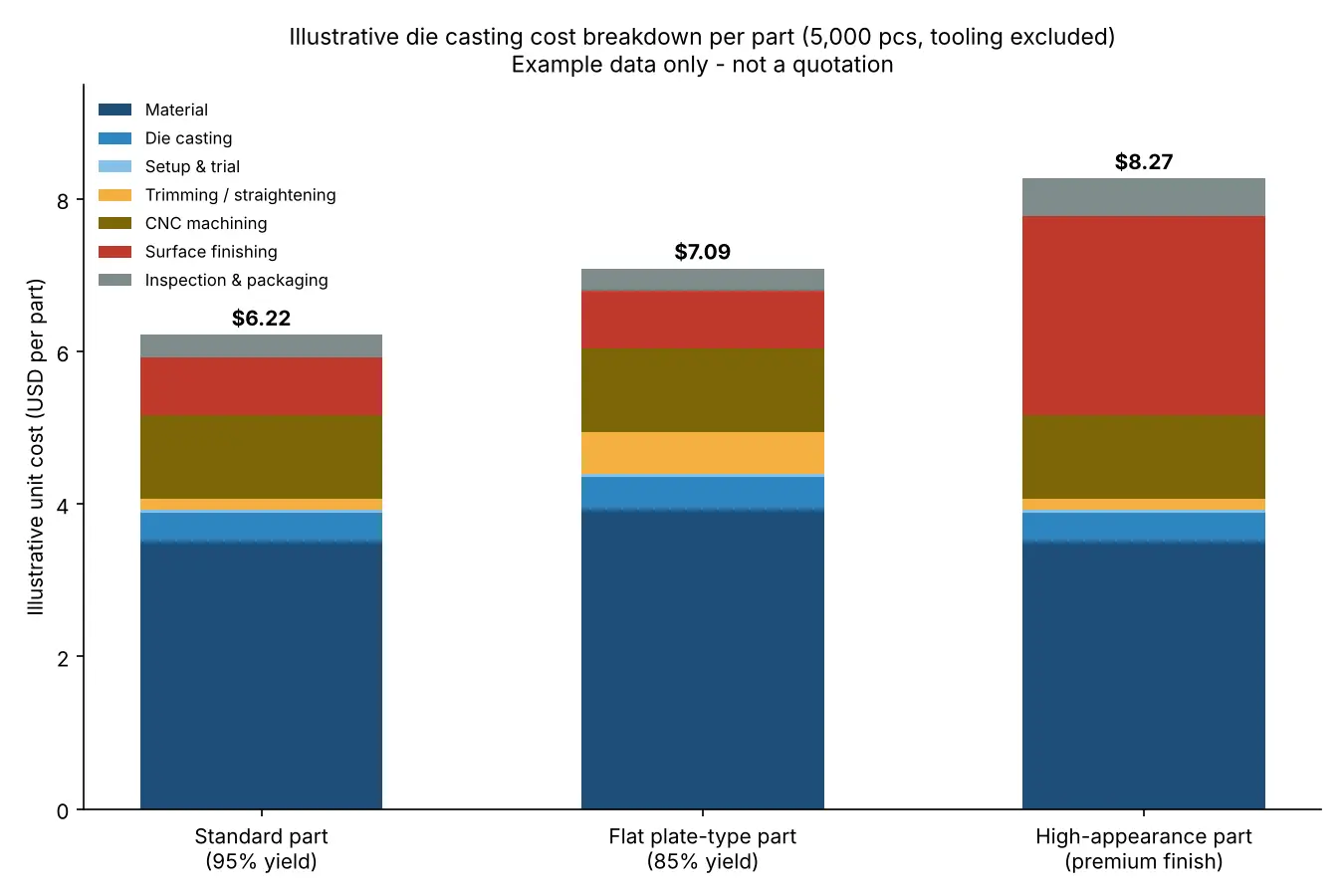
Illustrative example data. Not a quotation and not actual RuiYu pricing.
| Cost item (USD per part) | Standard part | Flat plate-type part | High-appearance part |
|---|---|---|---|
| Material | 3.50 | 3.92 | 3.50 |
| Die casting | 0.39 | 0.44 | 0.39 |
| Setup and trial | 0.03 | 0.03 | 0.03 |
| Trimming / straightening | 0.15 | 0.55 | 0.15 |
| CNC machining | 1.10 | 1.10 | 1.10 |
| Surface finishing | 0.75 | 0.75 | 2.60 |
| Inspection and packaging | 0.30 | 0.30 | 0.50 |
| Unit cost (tooling excluded) | 6.22 | 7.09 | 8.27 |
In the flat plate-type column, yield is assumed to be 85% and effective metal consumption 1.12 kg per accepted part. In the high-appearance column, only surface finishing and inspection change.
8. Why Order Quantity Changes the Unit Cost
A larger order spreads setup, trial and inspection work over more parts, and allows steadier scheduling. The effect is real but not unlimited. Material price, yield and machining requirements often matter more than quantity.
Same example part, same die and process:
| Cost item (USD per part) | 500 pieces | 5,000 pieces |
|---|---|---|
| Material | 3.50 | 3.50 |
| Die casting | 0.39 | 0.39 |
| Setup and trial | 0.30 | 0.03 |
| Trimming | 0.15 | 0.15 |
| CNC machining | 1.20 | 1.10 |
| Surface finishing | 0.80 | 0.75 |
| Inspection and packaging | 0.40 | 0.30 |
| Unit cost (tooling excluded) | 6.74 | 6.22 |
These figures are hypothetical and do not represent a guaranteed volume discount. When you request quotations, ask for several realistic quantities, such as 500, 2,000 and 5,000 pieces, so you can compare inventory investment against unit cost.
9. CNC Machining and Surface Finishing
CNC machining cost depends on the number and complexity of machined features, tolerances, machining time per part, fixtures, drilling and tapping, and inspection after machining. A part with several precision mounting surfaces can cost much more to machine than a part of the same weight with fewer critical features. Send 2D drawings and 3D models so the supplier can estimate it properly.
Surface finishing depends on the process, surface area, coating thickness, appearance requirement and inspection standard. Aluminum die castings can be shot blasted, e-coated (KTL), powder coated or painted. Our aluminum die cast motor casing case, for example, is shot blasted and KTL coated.
The process must suit the alloy. Common die casting alloys such as ADC12 and A380 contain a high level of silicon, so decorative anodizing on them usually gives limited results. If you need a specific appearance, tell the supplier early.
Also confirm whether masking, pretreatment, color matching, coating inspection and protective packaging are included in the quoted finishing price.
10. Should Tooling Be Included in the Unit Cost?
Tooling is a one-time investment, while unit cost is incurred on every part. They are normally quoted separately, which makes quotations easier to compare. For project budgeting, you can still spread the tooling over the planned quantity:
Project cost per unit = (Total part manufacturing cost + Tooling investment) ÷ Total accepted parts
Using the example part at 5,000 pieces ($6.22 per part) and an $8,000 tooling investment:
- Total manufacturing cost: 5,000 × $6.22 = $31,100
- Total project cost: $31,100 + $8,000 = $39,100
- Effective project cost: $39,100 ÷ 5,000 = $7.82 per part
The recurring manufacturing cost stays at $6.22. The extra $1.60 is the tooling spread over 5,000 parts. If the same die produces 20,000 accepted parts, the tooling share falls to $0.40 per part (assuming no additional tooling cost). This is why the planned lifetime volume matters so much when comparing prototype quantities with mass production. See also our die casting tooling capabilities.
11. Common Mistakes When Comparing Unit Costs
- Comparing different scopes. One supplier quotes a raw casting, another a machined and finished part.
- Using finished weight as metal consumption. Runners, overflows and scrap are ignored.
- Ignoring yield. Scrap and rework consume machine time and money.
- Assuming a simple shape means a low price. Flat plate-type parts and high-appearance parts can cost far more than they look.
- Assuming higher quantities always lower the price. Other factors can outweigh volume.
- Mixing tooling with part price. Separate quotations are easier to evaluate.
- Leaving out quality and delivery requirements. Tighter tolerances, more inspection, special packaging and short lead times all add cost.
12. How to Get a More Accurate Estimate
Start with complete information, not just a photo. Prepare:
- Drawings: 2D drawing with dimensions, tolerances and critical features; 3D model if available.
- Alloy: such as ADC12 or A380, if specified.
- Estimated weight: finished part weight, if known.
- Quantity: annual demand and quantity per order.
- Secondary operations: CNC machining, drilling, tapping and others.
- Surface treatment and appearance requirement: coating, color, corrosion and cosmetic requirements.
- Quality requirements: critical dimensions, inspection standard and acceptance criteria.
- Tooling: whether a new die is needed, quoted separately.
If some of this is not available yet, a supplier can give a preliminary estimate based on stated assumptions, to be updated once the drawings are confirmed. To build your own estimate, use the formulas above with your own alloy price, machine rate, yield and finishing cost.
FAQ
How much does a die casting cost per piece?
It depends on the part, not just its weight. Material, scrap rate, machine time, machining, surface finishing and order quantity all change the result. The examples in this guide show how, but they are illustrations. A real price needs your drawing, alloy, quantity and finishing requirements.
Is tooling cost included in the die casting unit price?
Normally not. Tooling is quoted as a separate one-time item. For budgeting, you can spread it over the planned quantity to see an effective cost per part.
Why can a simple-looking casting cost more than expected?
Some shapes are difficult to cast even when they look simple. Flat plate-type castings, for example, can have a high scrap rate and tend to deform, which adds straightening and handling cost. Parts with a high appearance requirement can also cost much more in surface finishing than in casting.
What information do I need to send for a quotation?
A 2D drawing, preferably with a 3D model, the alloy, expected quantity, any machining, the surface finish and appearance requirement, and quality requirements. Tell us whether you need a new die.
Contact
If you are sourcing aluminum die castings, send us your drawings, estimated quantity, alloy and finishing requirements. We review the drawings and quote the casting and finishing work we handle. See our custom die casting components for the types of parts we make.
Contact RuiYu to discuss your aluminum die casting project.