
How OEM Aluminum Speaker Baskets Prevent Voice Coil Rubbing & Power Compression
Quick Summary for OEM Engineers & Sourcing Managers:
Voice Coil Rubbing Solution: Maintaining concentricity within ±0.08mm to 0.12mm between top plate pilot and spider step via secondary CNC turning reduces driver assembly line QC rejections below 0.3%.
Thermal Advantage: JIS ADC12 aluminum (approx. 96 W/m·K) dissipates motor heat twice as fast as stamped steel (approx. 45 W/m·K), preventing power compression during long-term high-power operation.
Tooling Investment: Premium H13 tool steel with multi-stage nitriding guarantees a die casting mold lifespan of 80,000–100,000 shots (3–5 years volume production).
Introduction
Selecting a high-precision die-cast aluminum speaker basket is critical for pro-audio driver assembly。Nothing frustrates a pro-audio driver assembly line faster than a high-power woofer emitting intermittent rubbing noises at final QC. Or worse—receiving field warranty returns from overseas distributors because continuous 500W operation caused SPL drop due to severe motor thermal buildup.
In our 20+ years of die casting manufacturing experience, we’ve analyzed hundreds of driver field failures. More often than not, the root cause traces back to subtle mechanical deflection or thermal bottlenecks in the speaker basket (frame).
When a heavy magnet structure hangs on a weak frame, micro-flexing misaligns the voice coil in tight magnetic gaps. When heat can’t escape, power compression kicks in.
This guide breaks down the technical auditing criteria pro-audio procurement teams should evaluate when sourcing OEM die-cast aluminum speaker baskets.
1. OEM Procurement Audit Checklist: 5 Core Performance Metrics
When auditing a speaker basket supplier for high-volume production, sound engineering teams must look beyond superficial appearances:
-
Concentricity & Pilot Alignment: The concentricity between the frame center, spider landing, and top plate pilot must be held within ±0.08mm to 0.12mm via precision CNC turning. This ensures zero voice coil rubbing even in tight 1.0mm magnetic gaps.
-
Structural Yield Strength: For heavy-duty 15-inch to 24-inch subwoofer frames, 3D reinforcement ribs must be engineered to withstand mechanical deflection caused by heavy ferrite or neodymium magnets during transport vibration.
-
Thermal Sink Capacity: High-power drivers generate intense voice coil temperatures (>200°C). A thermally conductive frame acts as an active heat sink.
-
Precision CNC Machining: Raw casting surfaces are never flat enough for spider bonding. Secondary CNC facing on the spider landing guarantees flat, continuous contact.
-
Batch Consistency: Dimensional stability across 10,000-piece runs prevents line adjustments and keeps downstream assembly defect rates below 0.3%.
2. The True Cost of Non-Conformance in Loudspeaker Production
In OEM transducer manufacturing, minor casting defects rarely trigger instant visual rejection—they manifest as field failures after 100+ hours of heavy use:
-
Concentricity Deviation > 0.15mm: Causes voice coil rubbing under high excursion, resulting in >5% line rejections or expensive manual disassembly.
-
Spider Landing Micro-Porosity: Air leaks through porous castings alter Thiele-Small parameters (shifting $F_s$), ruining the vented box alignment designed by acoustic engineers.
-
Flange Deformation: Uneven pressure on the enclosure gasket leads to cabinet air leakage and low-frequency buzz complaints from end-users.
3. Material Selection: Why JIS ADC12 Aluminum Dominates Pro-Audio
While entry-level drivers rely on stamped steel, professional active speakers and touring subwoofers overwhelmingly specify specialized aluminum alloys such as JIS ADC12 (ASTM A383).
-
High Thermal Conductivity: ADC12 transfers heat at ~96 W/m·K, compared to stamped steel’s ~45 W/m·K. Lower coil temperatures mean less resistance increase and minimal thermal power compression.
-
Non-Magnetic Integrity: Aluminum is non-magnetic, preventing stray magnetic field distortion around the motor gap and maintaining BL symmetry.
-
Complex 3D Ventilation Geometry: High-pressure die casting (HPDC) allows engineered back-venting windows under the spider landing, promoting air convection during high-excursion cone movement.
(Learn more about our full range of custom aluminum die casting services].
4. Tooling Lifespan & Project Timeline Benchmarks
For custom driver projects, custom mold tooling represents a key upfront capital expense. Transparency in tooling amortization is vital for procurement planning.
At RuiYu, we utilize premium H13 tool steel with multi-stage nitriding treatment. This guarantees a mold lifespan of 80,000 to 100,000 shots for ADC12 aluminum—covering 3 to 5 years of steady mass production.
Typical Custom Project Timelines:
-
DFM & Moldflow Simulation: 5–7 business days.
-
T0 First Article Samples: 35–40 business days after design freeze.
-
Mass Production Lead Time: 4–5 weeks following sample approval.
5. Surface Finishing: Powder Coating vs. E-Coating
Surface treatment for speaker frames isn’t just cosmetic—it directly impacts driver cleanliness and installation durability.
-
E-Coating (Electrophoretic Deposition): Provides an ultra-thin, uniform anti-corrosion layer that covers complex interior ribs without buildup on critical CNC-machined steps.
-
Textured Powder Coating: Offers high-scratch resistance during pneumatic screwdriver assembly and provides a premium tactile finish (Wrinkle Black, Satin Black, or OEM RAL Colors).
-
Gap Contamination Protection: High paint adhesion prevents flaking paint chips from migrating into the magnetic gap—a leading cause of mysterious high-frequency noise artifacts.
6. Process Control: How RuiYu Eliminates Casting Porosity
Porosity is the enemy of structural strength. To ensure dense aluminum structures across thin ventilation ribs, our foundry enforces strict process controls:
-
Moldflow-Driven Gating Design: Runner systems are simulated prior to cutting H13 steel to eliminate air entrapment and shrinkage voids in load-bearing spokes.
-
Precise Melt Temperature Control: Molten ADC12 is maintained at strict 640°C – 680°C ranges with automated degassing to prevent cold shuts and oxide inclusions.
-
Balanced Ejection Mechanics: Automated ejector pin distribution and optimized draft angles (1.5°–3.0°) prevent micro-fractures during part ejection.
We conduct density index checks and spot X-ray inspection on production batches before parts proceed to secondary CNC turning.
7. Visual Factory Walkthrough
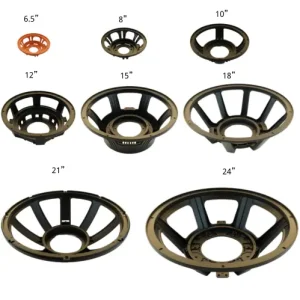
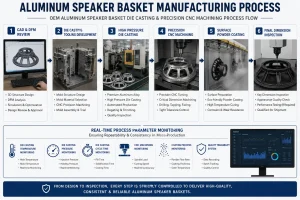
If you are developing a proprietary driver line, partnering with a supplier that understands custom die-cast speaker basket manufacturing is essential for maintaining acoustic performance and assembly line efficiency. Below is a look into our production capabilities:
Frequently Asked Questions (FAQ)
Q1: Can RuiYu supply existing speaker basket molds to save tooling costs? Yes. We maintain a library of standard tooling for popular 8″, 10″, 12″, and 15″ frame designs. For proprietary audio designs, we specialize in rapid custom mold development.
Q2: What files do you need for a custom speaker basket RFQ? Please provide 3D CAD files (STEP/IGES), 2D drawings with tolerance requirements, target order quantities, and preferred surface finish.
Q3: How do you prevent paint overspray on CNC pilot surfaces? We use custom silicone masking jigs during powder coating or E-coating to keep pilot diameters and mounting steps bare metal, ensuring exact metal-to-metal contact during motor assembly.
Need a Feasibility Review for Your Speaker Basket Design?
Don’t let unverified frame tolerances compromise your speaker line’s acoustic performance.
RuiYu provides Free DFM & Moldflow Evaluation for new speaker basket projects. Our engineering team will review your 3D CAD drawings for draft angles, wall thickness uniformity, and casting feasibility—obligation-free.

