
Zinc vs aluminum die casting is a choice many OEM projects have to make. The choice affects part weight, wall thickness, tooling life, surface finish and the cost of each part.
Short answer: zinc usually suits small, detailed parts with tight tolerances, plated or decorative finishes, and long production runs. Aluminum usually suits larger or weight-critical parts, and parts that see sustained heat. Many parts sit between the two, so the choice should be made from the drawing and the application, not from habit.
The numbers in this guide are typical published reference values. They are not RuiYu test results and not a quotation. Your alloy, part geometry and die design will change them.
Quick Comparison
The table below compares zinc vs aluminum die casting on the factors that matter most for an OEM part.
| Factor | Zinc (for example Zamak 3) | Aluminum (for example A380, ADC12) |
|---|---|---|
| Casting process | Hot-chamber machine | Cold-chamber machine |
| Density | about 6.6–6.7 g/cm³ | about 2.7 g/cm³ |
| Tensile strength (typical) | Zamak 3 ≥ 280 MPa; Zamak 5 ≥ 330 MPa | ADC12 235–310 MPa; ADC10 / A380 230–320 MPa |
| Elongation (typical) | Zamak 3 ≥ 10% | ADC12 / ADC10 1.5–3.5% |
| Hardness (typical) | 80–90 HBW | about 75 HBW |
| Thermal conductivity | about 109–113 W/m·K | about 96 W/m·K |
| Typical casting temperature | about 400 °C | about 660 °C |
| Minimum section thickness (general design guide) | about 0.63 mm | about 0.89 mm |
| Typical maximum die life (published reference) | about 1,000,000 shots | about 100,000 shots |
| Common finishes | Plating, chromate conversion, wet paint | Shot blasting, e-coating (KTL), powder coating, paint |
| Best fit | Small to medium, detailed, plated or decorative parts | Larger, lighter parts; sustained heat |
Sources for the table: density, strength, elongation, hardness and thermal conductivity come from our Die Casting Materials Guide, which notes that mechanical properties depend on alloy composition, casting parameters, part geometry and testing conditions. Casting temperature, section thickness and die life come from Wikipedia: Die casting; the die-life and section-thickness figures are upper-end, general values from a NADCA-based table. Alloy standards differ: A380 is an ASTM/AA designation and ADC12 is a JIS designation, so they should not be treated as identical.
1. The Process Is Different
Zinc melts at a much lower temperature than aluminum. Zamak 3 solidifies at about 381–387 °C, so zinc can be cast on a hot-chamber machine, where the injection system sits in the molten metal. Aluminum is cast on a cold-chamber machine, where metal is ladled into a shot sleeve and then injected into the die.
This difference carries through the whole project. Lower casting temperature puts less thermal load on the die, and the shorter metal path of a hot-chamber machine allows faster cycles. Aluminum parts typically run on slower cycles and put more heat stress on the tooling.
2. Weight and Part Size
Zinc is roughly two and a half times as dense as aluminum. For a part of 100 cm³:
- Zinc (Zamak 3, 6.60 g/cm³): about 660 g
- Aluminum (ADC12, 2.74 g/cm³): about 274 g
If the part is held, carried, moved or mounted on something that moves, that difference decides a lot. For small hardware, weight often does not matter, and some products even benefit from the heavier, solid feel of zinc.
Part size is the other limit. In practice, large parts are rarely made in zinc. A large zinc part is heavy, so the material cost per part rises quickly, and the hot-chamber machines used for zinc are generally smaller than the cold-chamber machines available for aluminum. For large housings, covers and brackets, aluminum is usually the practical choice. Zinc is at its best on small and medium parts, especially those with fine detail.
It also affects cost. Do not compare the two metals by price per kilogram. Material cost per part depends on the volume of the part, the density and the metal price. A cheaper metal per kilogram can still cost more per part if the part is heavy. Our guide on how die casting cost per unit is built shows the full formula.
3. Strength and Temperature
Zinc is not the weaker metal. Using the typical values in our materials guide, Zamak 3 has a tensile strength of at least 280 MPa and Zamak 5 at least 330 MPa, while ADC12 and ADC10 / A380 aluminum alloys fall in the range of about 230–320 MPa. Zinc alloys are also more ductile, with Zamak 3 at 10% elongation or more against 1.5–3.5% for the aluminum alloys listed. These are typical values: they depend on alloy composition, casting parameters, part geometry and testing conditions.
So the question is rarely “which is stronger”. It is strength per unit of weight, and what happens at temperature:
- Zinc suits room temperature or moderate heat, and loads that are not sustained for very long periods.
- Aluminum gives a better strength-to-weight ratio, because it is much lighter at similar strength.
- Aluminum is usually the safer choice as sustained temperature and thermal cycling increase.
Thermal conductivity does not separate the two. Typical values in the guide are about 96 W/m·K for ADC12 and about 109–113 W/m·K for the Zamak alloys. Aluminum is chosen for heat-dissipating housings often because it is lighter and holds up better under sustained heat, not because it conducts better.
If your part works near a motor, a lamp or any heat source, treat temperature as a first-order requirement and state it in the RFQ.
4. Thin Walls, Detail and Tolerance
Zinc fills thin sections and fine details well. A commonly used general design table gives a minimum section thickness of about 0.63 mm for zinc and about 0.89 mm for aluminum. The International Zinc Association’s design guidance also notes that on small zinc parts, walls under 0.5 mm are possible close to the gate. For small parts with ribs, small bosses, logos or thin features, zinc has an advantage.
On tolerance, the International Zinc Association lists a normal minimum linear tolerance of about 0.2% of the dimension for zinc die castings, with about 0.1% achievable on suitable features. Aluminum parts can also hold tight dimensions, but larger sizes, thicker sections and shrinkage usually mean more allowance, and critical features are often machined afterwards.
Both depend on part size, parting line position and die design. ISO 8062-3 defines casting tolerance grades and is the normal reference. Give your tolerance requirements on the drawing and mark which features are critical. Tolerances that are not needed add cost.
5. Tooling Life and Cost Structure
Zinc’s lower casting temperature is gentler on the die. Published reference figures put the maximum die life of zinc at around 1,000,000 shots, compared with around 100,000 for aluminum. These are upper-end values, not a guarantee. Actual life depends on the part geometry, die steel, maintenance and process.
For a small part with a long program, longer die life can lower the tooling cost per part. For a part that needs only a small quantity, the difference may not matter. See our die casting tooling page for how tooling is reviewed, and the cost guide above for spreading tooling over the planned quantity.
The total unit cost also includes trimming, machining and finishing. For some parts the finish costs more than the casting.
6. Surface Finish
Zinc takes plating, chromate conversion coating and wet paint well. If you need chrome, nickel or other decorative plating, zinc is often the more natural starting point.
Aluminum die castings are commonly shot blasted, e-coated (KTL), powder coated or painted. Common die casting alloys such as A380 and ADC12 contain high levels of silicon, so decorative anodizing on them usually gives limited results. If you need a specific appearance, say so at the start of the project.
Finish requirements can reverse the material choice, so decide the finish together with the metal.
7. Zinc vs Aluminum Die Casting: A First-Pass Decision Guide
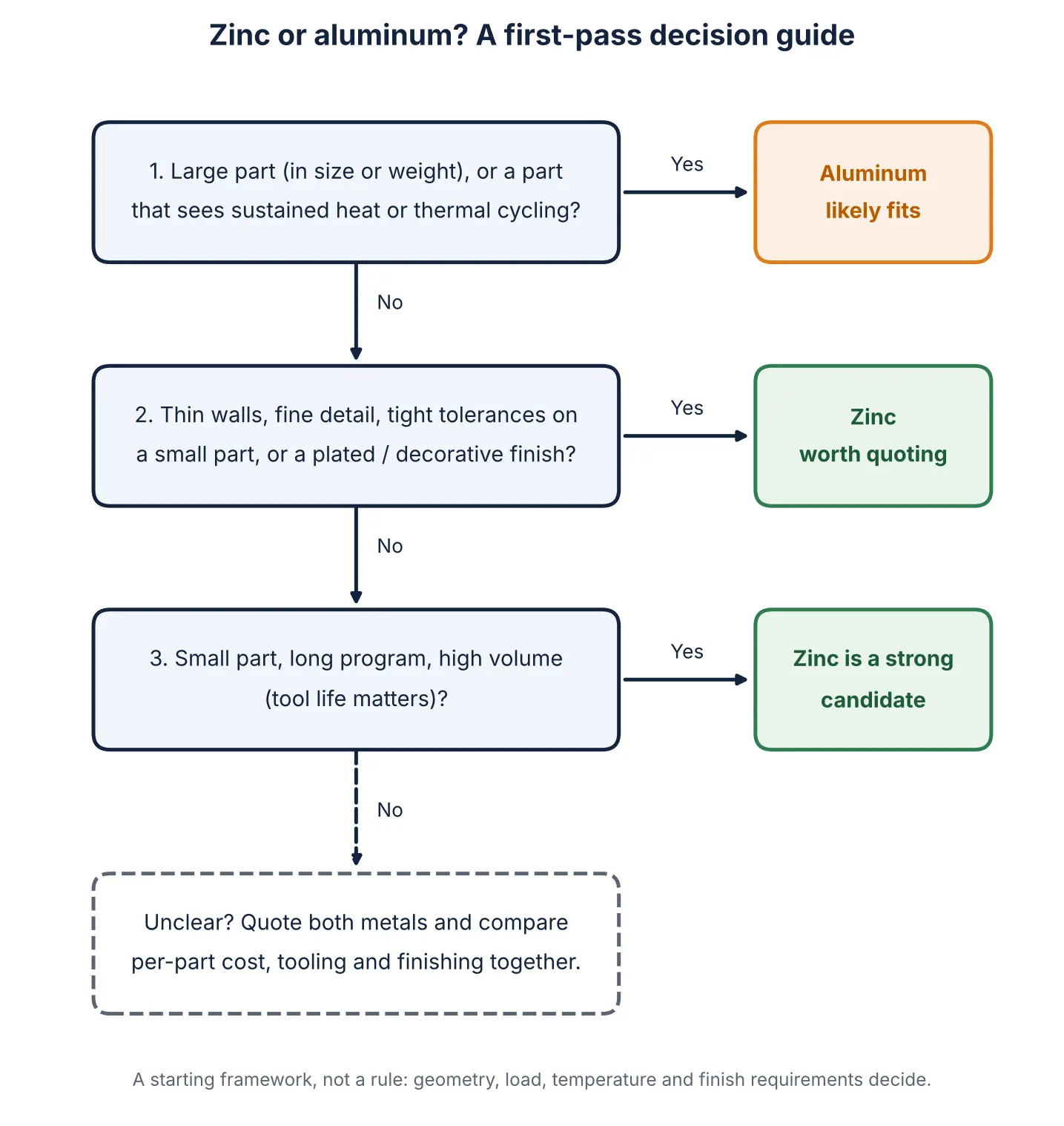
A starting framework, not a rule. Geometry, load, temperature and finish requirements decide.
| If your part… | Lean toward |
|---|---|
| Is large in size or weight, thin-shelled, or must be light | Aluminum |
| Sees sustained heat or thermal cycling | Aluminum |
| Is small with fine detail, thin ribs or small features | Zinc |
| Needs chrome, nickel or other decorative plating | Zinc |
| Is small, high volume and runs for years | Zinc (check tooling life) |
| Fits none of the above clearly | Quote both |
Our own product pages show the pattern. Hardware such as the carriage door hinge and locker door handle is a typical zinc application. Larger or heat-related parts such as motor housings and reducer components are typical aluminum applications. These are examples of how the choice usually goes, not rules.
8. What to Send With Your RFQ
For a material recommendation, send:
- 2D drawing and 3D model, with the critical dimensions marked.
- The approximate size and weight, or volume.
- Working temperature and any thermal cycling.
- Loads and how the part is mounted.
- The surface finish required, such as plating, powder coating or none.
- Appearance requirements: which surfaces are visible.
- Annual quantity and expected program length.
- The alloy, if you already have a specification.
If you do not know the material yet, say so. An engineering review of the drawing before quotation is the most reliable way to avoid redesign later. You can send us your drawings for review.
9. Common Mistakes
- Comparing metals by price per kilogram. Weight per part and cycle time change the result.
- Choosing aluminum only because it sounds lighter and “stronger”. Zinc is strong at room temperature, and for small parts the weight difference may not matter.
- Choosing zinc for a part that runs hot. Sustained heat is the usual reason to choose aluminum.
- Deciding the finish last. A plated finish is a common reason to choose zinc, so a finish requirement can reverse the decision.
- Assuming a part can be moved from one metal to the other. A die is made for a specific alloy and machine type, so a change normally means a design review and new tooling.
- Over-specifying tolerances. Tight tolerance on non-critical features adds cost.
FAQ
Is zinc or aluminum die casting cheaper?
It depends on the part. Zinc cycles faster and tooling can last longer, but zinc is heavier per volume. Aluminum is lighter, but cycles are slower and tooling life is shorter. Ask for a quotation in both metals when the choice is open, and compare per-part cost, tooling and finishing together.
Is zinc stronger than aluminum?
Not in a simple way. Typical tensile values for zinc alloys such as Zamak 3 and Zamak 5 (at least 280–330 MPa) are comparable to or higher than those of common aluminum die casting alloys (about 230–320 MPa). Aluminum gives better strength for its weight and keeps its properties better as temperature rises. Check the datasheet of the specific alloy for your requirements.
Can I switch an existing part from aluminum to zinc, or the reverse?
Usually not without changes. The dies are made for a specific alloy and machine type, and wall thickness, draft and mounting features may need adjusting. Ask for an engineering review before deciding.
What should I send to get a material recommendation?
A drawing and 3D model, the part size or weight, working temperature, loads, the finish you need, the annual quantity, and any tolerance on critical features. The checklist above lists what helps most.
Talk to Us About Your Part
If you are comparing zinc vs aluminum die casting for a part, send us your drawings, estimated quantity, working conditions and finish requirements. We review the drawing before quoting and can recommend which metal to quote. See our custom die casting components for the types of parts we work on.
Sources
- RuiYu Die Casting Materials Guide (density, tensile strength, elongation, hardness, thermal conductivity)
- Wikipedia: Zamak (Zamak 3 solidification range)
- Wikipedia: Die casting (casting temperature, minimum section, die life, hot- and cold-chamber machines)
- International Zinc Association: Zinc die casting design rules (zinc wall thickness and tolerance)