
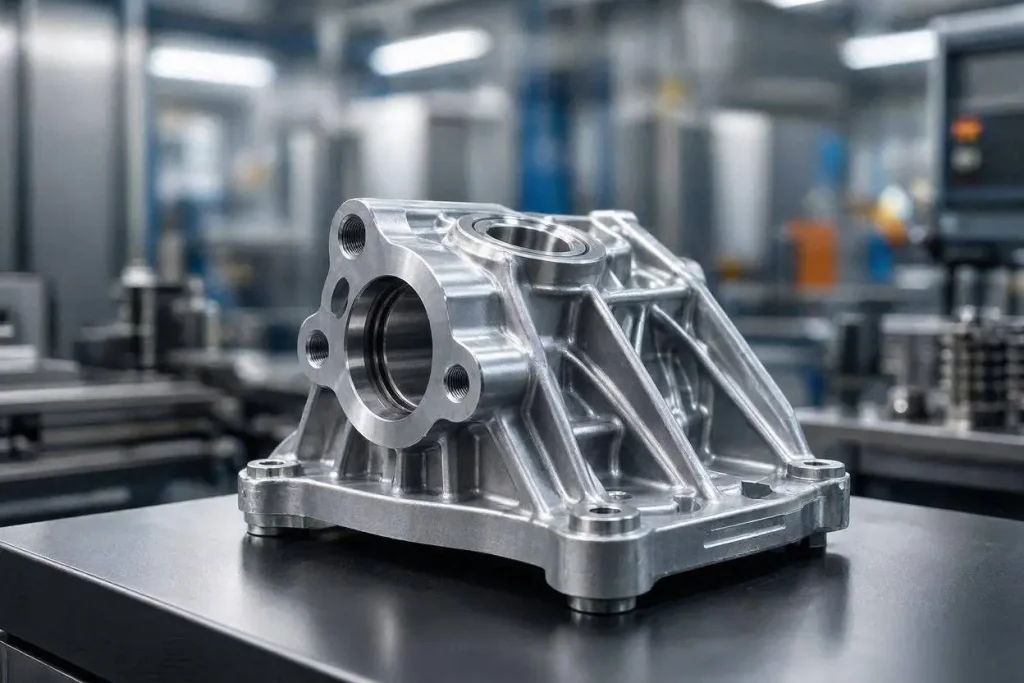
Beyond ADC12: Understanding High-Strength Aluminum Die Casting for OEM Components
How Advanced Alloy Selection and Process Optimization Improve Die Cast Part Performance
For many OEM applications, ADC12 and A380 aluminum alloys are widely used because of their excellent castability, dimensional stability, and cost efficiency. However, when components are required to withstand higher loads, repeated impact, vibration, or long-term fatigue conditions, standard die casting alloys may reach their performance limits.
In demanding industrial applications, material selection is only one part of achieving reliable performance. Alloy composition, microstructure control, casting parameters, and post-casting processes all influence the final mechanical properties of aluminum die cast components.
At RuiYu, we help OEM customers evaluate suitable aluminum die casting solutions by combining material knowledge with practical manufacturing experience, from mold design and die casting process optimization to machining and surface finishing.
1. Why Standard ADC12 May Not Meet High-Stress Application Requirements
ADC12 is one of the most commonly used aluminum die casting alloys worldwide due to its excellent fluidity, good corrosion resistance, and cost advantages.
However, for structural or high-load components, some applications may require improved:
- Tensile strength
- Impact resistance
- Fatigue performance
- Ductility under stress
Typical examples include:
- Electric motor housings
- Transmission or gearbox housings
- Pump bodies and industrial equipment components
- Structural brackets and mounting parts
- Heavy-duty mechanical components
2. How High-Performance Aluminum Die Castings Achieve Better Mechanical Properties
Improving aluminum die casting performance is not only about choosing a stronger alloy. The internal microstructure and manufacturing process also play important roles.
Microstructure Refinement for Better Ductility
During aluminum alloy solidification, the shape and distribution of silicon particles influence material toughness.
Through modification techniques such as strontium (Sr) treatment, coarse needle-like eutectic silicon structures can be refined into finer fibrous structures.
This helps:
- Reduce stress concentration points
- Improve resistance to cracking
- Enhance impact performance
For OEM components exposed to vibration or repeated loading, better microstructure control can contribute to longer service life.
Iron Phase Control for Improved Toughness
Iron content is commonly controlled in aluminum die casting because excessive iron phases may negatively affect ductility.
By managing alloy composition and controlling elements such as manganese (Mn), harmful needle-like iron structures can be reduced and transformed into more stable phases.
This helps maintain:
- Better toughness
- Improved casting performance
- Reduced risk of brittle fracture
Low-Temperature Aging for Stress Relief and Strength Improvement
Traditional high-temperature heat treatment methods, such as solution treatment used in T6 processes, may cause challenges for die castings because of internal porosity and trapped gas.
For suitable applications, controlled low-temperature aging treatments can provide:
- Internal stress relief
- Improved dimensional stability
- Enhanced mechanical properties
The actual performance depends on alloy composition, casting design, wall thickness, and process parameters.
3. ADC12 vs. High-Strength Aluminum Die Casting Materials
| Performance Factor | Standard ADC12 | Optimized High-Strength Aluminum Die Casting |
|---|---|---|
| Castability | Excellent | Good to Excellent |
| Cost Efficiency | High | Medium |
| Tensile Strength | Suitable for general applications | Higher performance potential |
| Ductility | Limited in high-stress applications | Improved through microstructure control |
| Application Range | General housings and covers | Structural and load-bearing components |
The right material choice depends on the specific requirements of each OEM project.
A stronger alloy is not always the best solution. Engineers must consider:
- Part geometry
- Production volume
- Cost targets
- Mechanical requirements
- Surface finishing requirements
4. Applications of High-Performance Aluminum Die Cast Components
High-performance aluminum die casting solutions are commonly used for OEM components where a combination of strength, rigidity, dimensional stability, and lightweight construction is required.
Typical applications include:
Electric Motor and Power Components
Examples:
- Motor housings
- End covers
- Gearbox housings
- Heat sink structures
Requirements:
- High rigidity
- Excellent dimensional stability
- Efficient heat dissipation
- Long-term durability under vibration and operating loads
Industrial Equipment Components
Examples:
- Pump bodies
- Valve housings
- Mechanical housings
- Structural mounting brackets
Requirements:
- Load-bearing capability
- Fatigue resistance
- Corrosion resistance
- Consistent performance in demanding environments
Automotive and Transportation Components
Examples:
- Transmission housings
- Chassis brackets
- Structural support components
- Lightweight aluminum housings
Requirements:
- High strength-to-weight ratio
- Impact resistance
- Dimensional accuracy
- Reliable mass production capability
Complex OEM Die Cast Parts
For many OEM projects, high-performance aluminum alloys enable manufacturers to produce lightweight, near-net-shape components with complex geometries.
Typical benefits include:
- Reduced machining requirements
- Improved production efficiency
- Consistent part quality
- Integration of multiple design features into a single casting
Beyond structural industrial components, RuiYu also provides aluminum and zinc alloy die casting solutions for specialized applications, including trailer security hardware and aluminum speaker baskets. Our engineering team supports OEM customers from tooling development to finished component production.
5. From Material Selection to Finished OEM Components
Choosing the right alloy is only the first step.
A successful die casting project requires integration of:
Engineering & Tooling
- Part design review
- Mold flow consideration
- Die casting mold development
Die Casting Production
- Alloy selection
- Process parameter optimization
- Quality control
Secondary Operations
- CNC machining
- Surface treatment
- Assembly
- Packaging
RuiYu supports OEM customers with integrated manufacturing solutions for aluminum and zinc alloy die cast components.
Frequently Asked Questions
What aluminum alloy is better than ADC12 for structural die cast parts?
ADC12 remains an excellent choice for many applications. However, when higher strength, toughness, or fatigue resistance is required, engineers may consider optimized aluminum alloy systems combined with improved casting processes.
The best material depends on the specific application requirements.
Can aluminum die casting replace CNC machining for high-strength components?
In many cases, aluminum die casting can produce near-net-shape components with complex geometries, reducing machining requirements and improving production efficiency.
The decision depends on part design, tolerance requirements, production volume, and performance expectations.
Can die cast aluminum parts be strengthened without traditional T6 heat treatment?
Some die cast aluminum components can achieve improved mechanical properties through alternative aging or stress-relief processes. The suitable approach depends on alloy composition, casting quality, and application requirements.
ADC12 remains an excellent choice for many applications. However, when higher strength, toughness, or fatigue resistance is required, engineers may consider optimized aluminum alloy systems combined with improved casting processes.
The best material depends on the specific application requirements.
In many cases, aluminum die casting can produce near-net-shape components with complex geometries, reducing machining requirements and improving production efficiency.
The decision depends on part design, tolerance requirements, production volume, and performance expectations.
Some die cast aluminum components can achieve improved mechanical properties through alternative aging or stress-relief processes. The suitable approach depends on alloy composition, casting quality, and application requirements.
Need Help Selecting the Right Aluminum Die Casting Solution?
Whether you are developing a new OEM component or looking to improve the performance of an existing design, RuiYu can support your project with:
- Aluminum and zinc alloy die casting
- Custom mold development
- CNC machining
- Surface finishing
- OEM assembly solutions
