
By Brian Fang | 20+ Years of Die Casting Industry Experience
Understanding different die casting types and selecting the right material is an important decision during product development. The choice affects not only the mechanical properties of the finished component, but also its weight, dimensional accuracy, surface finish, tooling requirements, production efficiency, and overall manufacturing cost.
Die casting is generally divided into cold chamber and hot chamber processes, while aluminum and zinc are among the most widely used alloys for industrial applications.
However, choosing between aluminum and zinc is not simply a matter of comparing material strength or price.
The best choice depends on the part geometry, required performance, production volume, surface finish, and manufacturing process.
This guide explains the main types of die casting and common die casting materials from a practical product-development perspective.
1. What Is Die Casting?
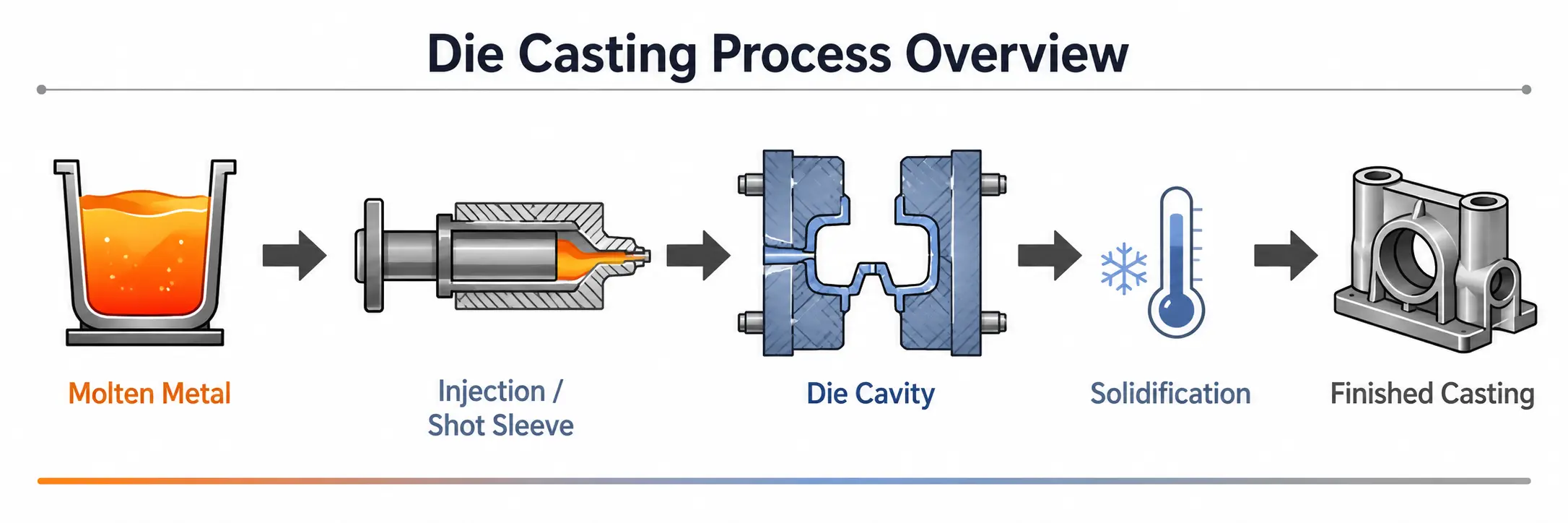
Die casting is a manufacturing process in which molten metal is injected into a reusable steel die under high pressure.
The die contains a precisely machined cavity that determines the shape of the finished component. After the molten metal fills the cavity and solidifies, the die opens and the casting is ejected.
Compared with many other casting methods, die casting can provide:
- High production efficiency
- Consistent dimensional accuracy
- Good surface finish
- Complex component geometries
- Thin sections and detailed features
- Reduced secondary machining requirements
For these reasons, die casting is widely used in automotive components, industrial hardware, electrical products, lighting components, motor parts, consumer products, and security hardware.
2. Major Die Casting Types: Cold Chamber vs. Hot Chamber
The two main die casting processes are cold chamber die casting and hot chamber die casting.
The major difference is how the molten metal is supplied to the injection system.
Cold Chamber Die Casting
In cold chamber die casting, the metal is melted in a separate furnace.
A measured amount of molten metal is transferred into the shot sleeve, and a hydraulic plunger pushes the metal into the die cavity at high speed and pressure.
Cold chamber die casting is commonly used for:
- Aluminum alloys
- Magnesium alloys
- Copper-based alloys
Why is aluminum normally die cast using a cold chamber?
The reason is not simply that aluminum has a higher melting temperature.
Molten aluminum can cause significant erosion and dissolution of ferrous components that remain in continuous contact with the molten metal. For this reason, conventional aluminum high-pressure die casting normally uses a cold chamber system.
Hot Chamber Die Casting
In hot chamber die casting, the injection system is integrated with the furnace.
The injection mechanism remains in contact with the molten metal, allowing the alloy to be injected directly into the die cavity during each cycle.
Hot chamber die casting is particularly suitable for lower-melting-point alloys such as zinc.
Advantages include:
- Fast cycle times
- High production efficiency
- Excellent repeatability
- Reduced metal transfer between cycles
- Excellent suitability for high-volume production
Zinc die casting is particularly well suited to this process.
3. Aluminum Die Casting
Aluminum is one of the most widely used materials in high-pressure die casting.
It provides a useful combination of low weight, strength, corrosion resistance, and thermal conductivity.
Key advantages of aluminum include:
- Low density
- Good strength-to-weight ratio
- Good corrosion resistance
- Good thermal conductivity
- Good electrical conductivity
- Good machinability
- Suitable for various surface treatments
Common aluminum die casting alloys include ADC12 and A380, although the appropriate alloy depends on the application and applicable standards.
When Is Aluminum a Good Choice?
Aluminum is often considered when the component requires:
Lightweight construction
Aluminum is significantly lighter than zinc, making it attractive for components where weight reduction matters.
Heat dissipation
Its thermal conductivity makes aluminum suitable for:
- Motor housings
- Heat sinks
- Lighting housings
- Electronic enclosures
Larger components
Aluminum is widely used for larger die-cast components such as:
- Automotive housings
- Gearbox housings
- Motor housings
- Structural brackets
4. Zinc Die Casting
Zinc is particularly attractive for small and medium-sized components requiring complex geometry, excellent dimensional stability, and good surface finishing.
Key advantages include:
- Excellent dimensional accuracy
- Good casting fluidity
- Good impact resistance
- Good hardness
- Excellent surface reproduction
- Good plating and painting characteristics
- High production efficiency
Zinc alloys such as Zamak 3 and Zamak 5 are widely used in industrial and consumer products.
When Is Zinc a Better Choice?
One common misconception is that aluminum is always the better material because it is lighter.
That is not necessarily true.
For a compact component where weight is less important, zinc can offer several advantages.
For example, zinc is often a good choice for:
- Locks
- Latches
- Handles
- Hardware
- Gears
- Small mechanical housings
- Security components
For these products, dimensional accuracy, complex geometry, surface finish, and production efficiency may be more important than low weight.
This is one reason zinc remains widely used in die-cast security hardware.
5. Magnesium Die Casting
Magnesium is the lightest commonly used structural metal in die casting.
Its main advantage is weight reduction.
Key characteristics include:
- Very low density
- Good strength-to-weight ratio
- Good stiffness
- Good machinability
- Good electromagnetic shielding properties
Magnesium die casting can be used in applications such as:
- Automotive components
- Electronic housings
- Portable equipment
- Aerospace-related components
- Lightweight structural parts
However, magnesium die casting requires appropriate process control and material handling, and it is generally selected for applications where weight reduction provides a significant benefit.
6. Copper-Based Die Casting
Copper and copper-based alloys can also be processed using specialized die casting methods.
Compared with aluminum and zinc, copper-based alloys are less commonly used in conventional high-pressure die casting because of their higher processing temperatures and greater demands on tooling and equipment.
Key characteristics include:
- Excellent electrical conductivity
- Excellent thermal conductivity
- Good wear resistance
- Good corrosion resistance
- High-temperature performance
Typical applications include:
- Electrical components
- Switchgear components
- Heat transfer components
- Specialized industrial parts
Copper-based die casting is generally considered when the electrical, thermal, or mechanical properties justify the additional manufacturing requirements.
7. Aluminum or Zinc: Which One Should You Choose?
This is where material selection becomes more interesting.
There is no universal answer.
Instead of asking:
Which material is stronger?
it is often better to ask:
Which material is more suitable for the complete product?
| Requirement | Aluminum | Zinc |
|---|---|---|
| Lightweight | ★★★★★ | ★★ |
| Complex small components | ★★★ | ★★★★★ |
| Dimensional accuracy | ★★★★ | ★★★★★ |
| Heat dissipation | ★★★★★ | ★★★ |
| Surface finishing | ★★★★ | ★★★★★ |
| Small precision hardware | ★★★ | ★★★★★ |
| Larger structural parts | ★★★★★ | ★★★ |
| Locks & security hardware | ★★★ | ★★★★★ |
| High-volume production | ★★★★★ | ★★★★★ |
This comparison is a general guide. Final material selection should be based on the actual component design, required performance, production volume, and manufacturing process.
8. Material Selection Should Start With the Product, Not the Material
One of the most important lessons in die casting is that material selection should not be considered separately from product design.
The same component may have completely different manufacturing requirements depending on the selected alloy.
For example, a design optimized for zinc die casting may not be directly transferable to aluminum die casting.
The following factors should be considered together:
Part Geometry
Complexity, wall thickness, ribs, bosses, holes, and internal features all affect castability.
Required Performance
Consider:
- Strength
- Impact resistance
- Weight
- Operating temperature
- Corrosion resistance
- Wear resistance
Dimensional Requirements
Some applications require tight dimensional control, while others can accept wider casting tolerances.
The required accuracy should be defined before deciding whether additional CNC machining is necessary.
Surface Finish
The intended finish may include:
- Powder coating
- Painting
- Plating
- Polishing
- Other protective or decorative treatments
The selected alloy should be compatible with the intended surface treatment.
Production Volume
Die casting is particularly attractive for medium- and high-volume production because the tooling investment can be distributed across a large number of parts.
9. Practical Die Casting Selection Checklist
Before starting a new die casting project, consider these questions:
1. What material best matches the application?
Consider strength, weight, temperature, corrosion resistance, and surface requirements.
2. Is the geometry suitable for the selected alloy?
Wall thickness, filling distance, ribs, bosses, and other features should be reviewed.
3. Which dimensions are actually critical?
Not every dimension needs the same level of precision or CNC machining.
4. Which die casting process is appropriate?
The selected alloy and production requirements will determine whether hot chamber or cold chamber die casting is appropriate.
5. What secondary operations are required?
Machining, drilling, tapping, surface treatment, and assembly should be considered during the development stage.
6. What production volume is expected?
The expected annual volume has a direct impact on tooling economics and manufacturing strategy.
10. Die Casting Is a System, Not Just a Material
Choosing an alloy is only one part of developing a successful die-cast component.
A reliable project requires the material, casting process, product geometry, tooling, secondary operations, and production requirements to work together.
A useful way to think about die casting development is:
Application Requirements
↓
Part Design
↓
Material Selection
↓
Die Casting Process
↓
Tooling
↓
Secondary Operations
↓
Mass Production
A decision made early in the process can influence every step that follows.
This is why material and process selection should ideally be reviewed before the die casting mold is ordered.
Conclusion
Die casting offers an efficient way to produce complex metal components with consistent quality and high production efficiency.
Cold chamber die casting is commonly used for aluminum and other higher-melting-point alloys, while hot chamber die casting is particularly suitable for zinc and other lower-melting-point alloys.
Aluminum is often preferred when low weight, heat dissipation, and structural performance are important. Zinc can be an excellent choice when dimensional accuracy, complex geometry, surface finish, and efficient production are more important than weight.
The best material is therefore not necessarily the strongest, lightest, or cheapest option.
The right material is the one that provides the required performance while allowing the component to be manufactured reliably and economically.
RuiYu supports OEM projects involving zinc and aluminum die casting, from product development and tooling coordination to die casting, CNC machining, surface finishing, and finished component supply.


