
Die Casting Materials Guide: Aluminum & Zinc Alloy Selection
A practical engineering reference for selecting aluminum and zinc die casting alloys for custom die casting projects, including chemical composition, mechanical properties, physical characteristics, and international grade comparisons.
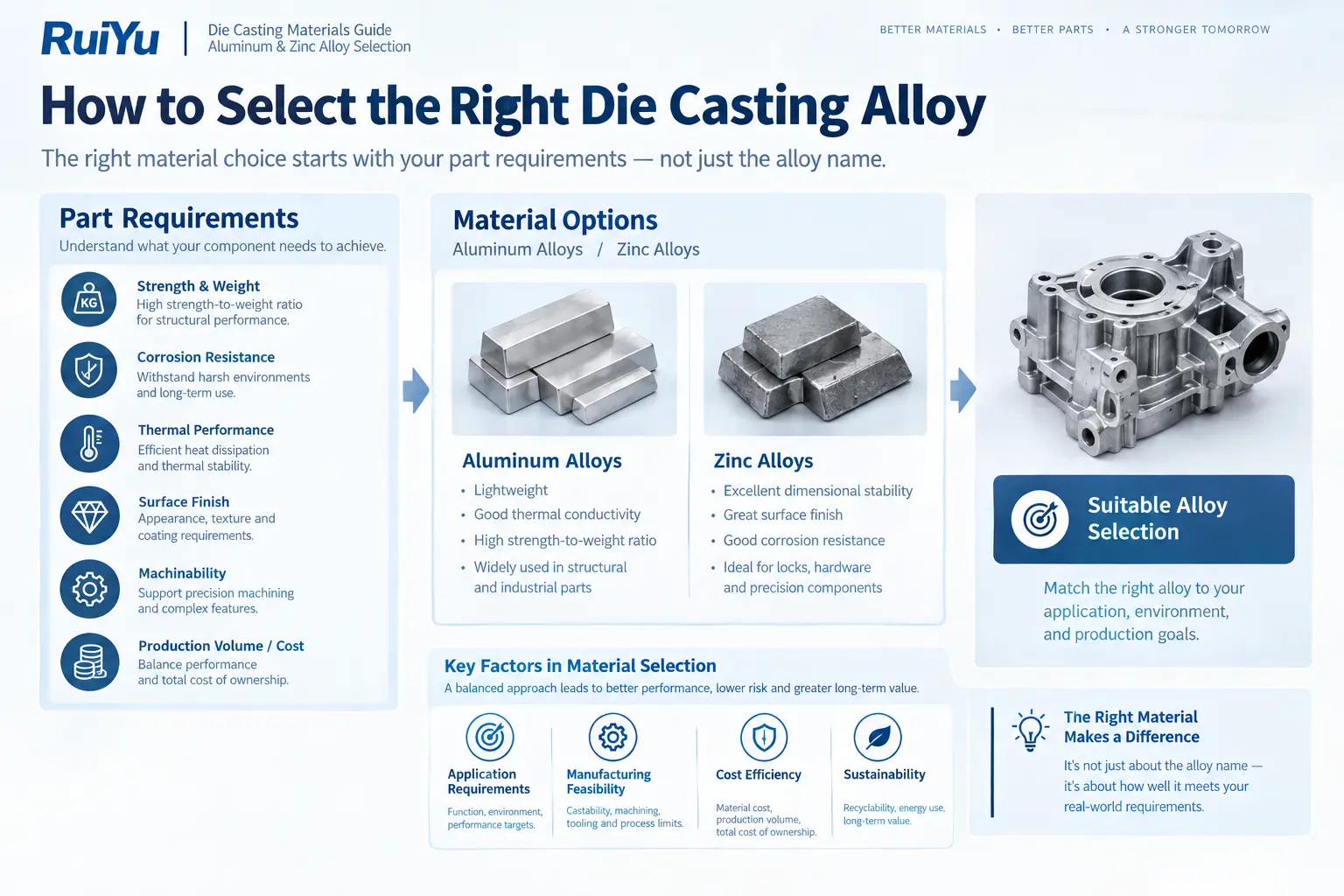
1.Why Material Selection Matters in Die Casting
Choosing the right alloy affects not only structural strength and corrosion resistance, but also casting performance, machining, surface finishing, manufacturing cost, and tooling considerations.
-
Weight & Structural Efficiency: High strength-to-weight ratios required for automotive, structural enclosures, and industrial components.
-
Thermal Management: Excellent thermal conductivity critical for LED lighting housings, heat sinks, and motor enclosures.
-
Surface Finishing & Precision: Alloy selection affects castability, dimensional replication, machining, and the achievable surface finish of components such as lock mechanisms and decorative hardware.
At RuiYu, we help customers select suitable alloys based on part function, production requirements, surface finishing needs, and cost considerations.
2.Common Aluminum Die Casting Alloys
Aluminum alloys are widely used in die casting because of their excellent strength-to-weight ratio, thermal conductivity, corrosion resistance, and manufacturing efficiency.
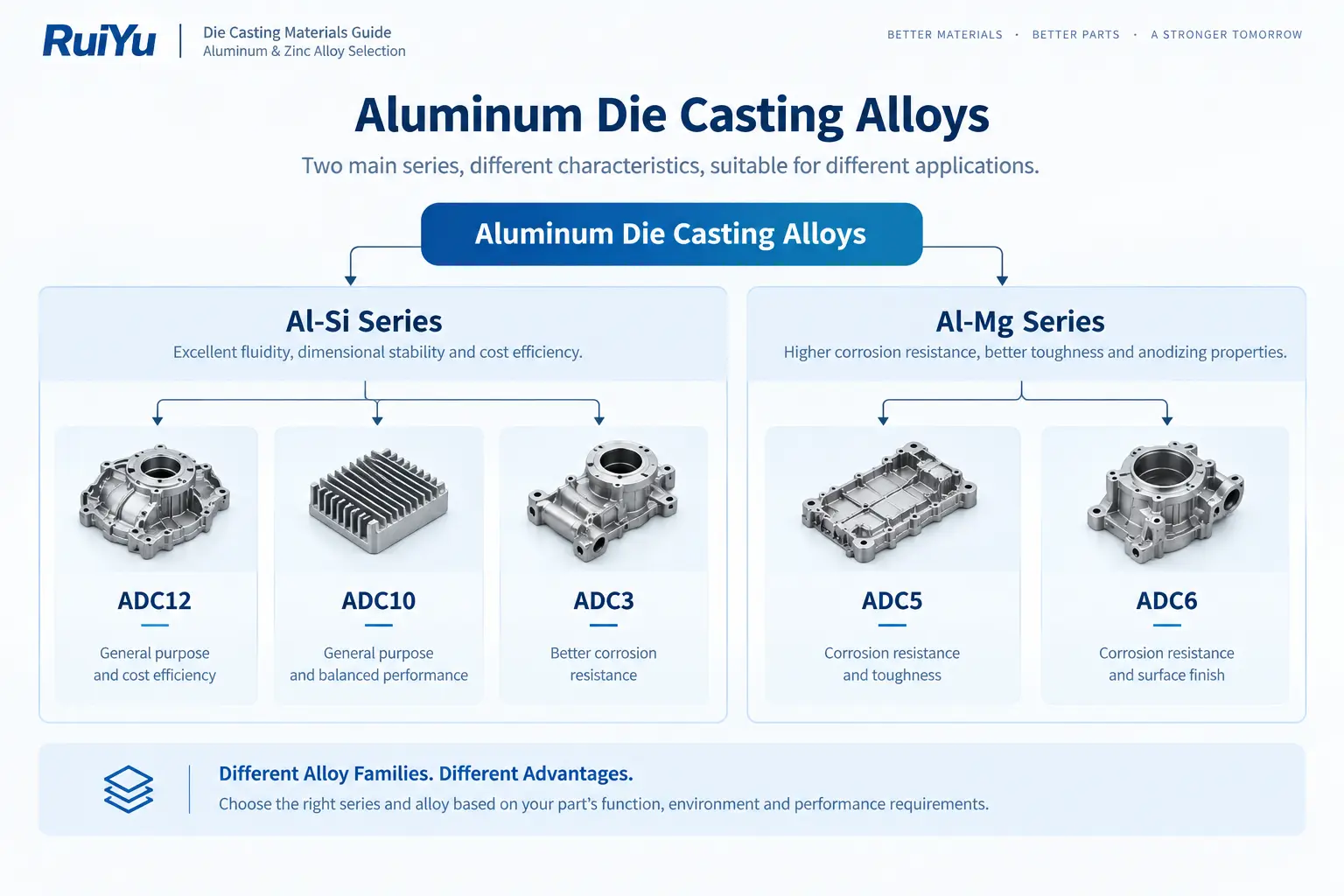
2.1 Aluminum-Silicon Series (Al-Si)
Al-Si alloys form the backbone of the die casting industry due to their exceptional casting fluidity, low shrinkage, and versatile mechanical balance.
Common Aluminum Die Casting Alloys Chemical Composition Comparison (%)
| Alloy Grade | Common Equivalent Grades | Silicon (Si) | Copper (Cu) | Magnesium (Mg) | Iron (Fe) | Zinc (Zn) |
| ADC12 | YL113 / A383 | 9.6 – 12.0 | 1.5 – 3.5 | ≤ 0.30 | ≤ 1.30 | ≤ 1.00 |
| ADC10 | YL112 / A380 | 7.5 – 9.5 | 2.0 – 4.0 | ≤ 0.30 | ≤ 1.30 | ≤ 1.00 |
| ADC3 | YL102 / A360 | 9.5 – 11.5 | ≤ 0.60 | 0.40 – 0.60 | ≤ 1.30 | ≤ 0.50 |
| ADC1 | YL104 / A413 | 11.0 – 13.0 | ≤ 0.60 | ≤ 0 |
Note: These comparisons are commonly referenced in global sourcing. Exact specifications should be confirmed according to the applicable JIS, GB, ASTM, or EN standards.
Alloy Characteristics & Applications
-
ADC12 / YL113: ADC12 is one of the most widely used aluminum die casting alloys due to its excellent fluidity, dimensional stability, and cost efficiency. It is commonly used for motor housings, lighting components, and industrial parts.
-
A380 / YL112: A380 provides a good balance of strength, corrosion resistance, and pressure tightness, making it suitable for automotive and structural components.
-
ADC3 / YL102: ADC3 provides improved corrosion resistance and pressure tightness, making it suitable for outdoor applications and fluid-related components.
2.2 Aluminum-Magnesium Series (Al-Mg – Specialized Alloys)
Aluminum-magnesium alloys such as ADC5 and ADC6 are used when corrosion resistance, ductility, and surface treatment requirements make them attractive alternatives to conventional Al-Si alloys.
Chemical Composition Comparison (%)
| Alloy Grade | Common Reference | Silicon (Si) | Magnesium (Mg) | Copper (Cu) | Iron (Fe) | Zinc (Zn) |
| ADC5 | JIS ADC5 | ≤ 0.30 | 4.0 – 5.5 | ≤ 0.10 | ≤ 1.00 | ≤ 0.30 |
| ADC6 | JIS ADC6 | ≤ 0.10 | 2.5 – 4.0 | ≤ 0.10 |
Key Characteristics of ADC5 / ADC6
-
High Corrosion Resistance: High magnesium content provides outstanding protection against harsh atmospheric, alkaline, and marine environments. Ideal for outdoor hardware, marine fittings, and heavy-duty valve housings.
-
Higher Ductility & Toughness: Compared to traditional Al-Si alloys, Al-Mg alloys deliver superior impact resistance and elongation, making them suitable for structural brackets and load-bearing applications.
-
Design & Process Considerations: Due to lower silicon content, ADC5 and ADC6 exhibit reduced casting fluidity and a narrower processing window. They are generally recommended for relatively simple geometries, moderate wall thicknesses, and carefully engineered tooling designs.
3.Zinc Die Casting Alloys (Zamak Series)
Zinc die casting is widely used for locks, handles, and precision hardware components requiring excellent surface finishing.
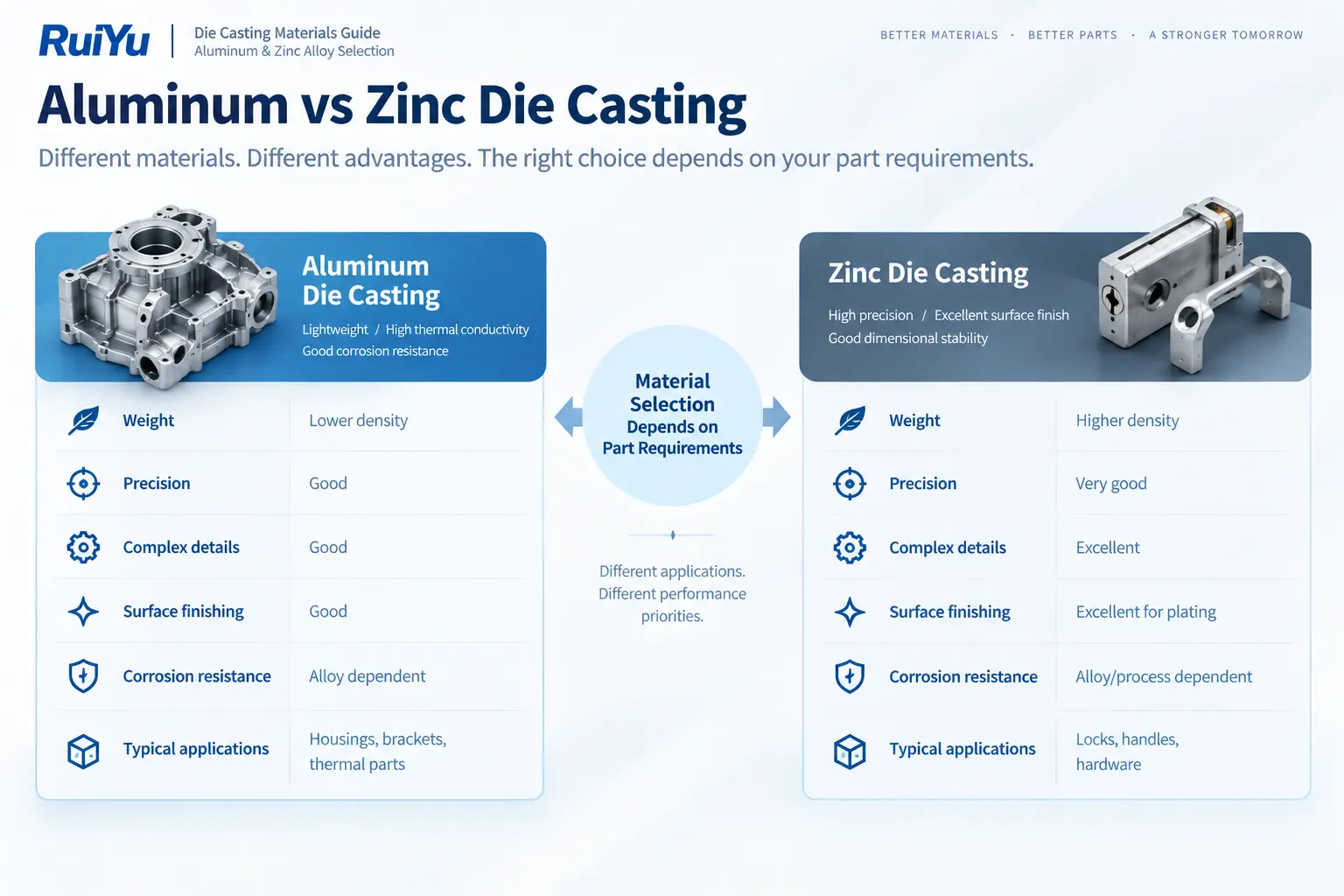
Why Choose Zinc Die Casting?
-
Excellent Surface Finish: Ideal for mirror polishing, electroplating (chrome, nickel, satin, gold), and decorative powder coating.
-
High Dimensional Accuracy & Tight Tolerances: Highly suited for lock cylinders, door handles, cabinet hardware, and micro-precision mechanisms.
-
Complex Geometry Capability: Exceptional fluidity allows ultra-thin wall sections, complex internal threads, and extended mold tool life.
Zinc Alloys Chemical Composition Comparison (%)
| Alloy Grade | Common Equivalent | Aluminum (Al) | Copper (Cu) | Magnesium (Mg) | Zinc (Zn) |
| ZDC2 | Zamak 3 / ZX03 | 3.5 – 4.3 | ≤ 0.10 | 0.02 – 0.06 | Balance |
| ZDC1 | Zamak 5 / ZX05 | 3.5 – 4.3 | 0.75 – 1.25 | 0.03 – 0.08 | Balance |
| ZA-8 | ZX08 | 8.0 – 8.8 | 0.80 – 1.30 |
4.Typical Mechanical Properties
Mechanical properties depend on alloy composition, casting parameters, part geometry, and testing conditions.
Aluminum Alloys
| Alloy | Tensile Strength (MPa) | Yield Strength (MPa) | Elongation (%) | Hardness (HBW) |
| ADC12 / A383 | 235 – 310 | ≥ 150 | 1.5 – 3.5 | 75 |
| ADC10 / A380 | 230 – 320 | ≥ 150 | 1.5 – 3.5 | 75 |
| ADC3 / A360 | 220 – 310 | ≥ 140 | 2.0 – 3.5 | 65 |
| ADC1 / A413 | 210 – 290 | ≥ 130 | 1.0 – 2.5 | 60 |
Zinc Alloys
| Alloy | Tensile Strength (MPa) | Impact Energy (J/cm²) | Elongation (%) | Hardness (HBW) |
| ZDC2 / Zamak 3 | ≥ 280 | ≥ 50 | ≥ 10.0 | 80 |
| ZDC1 / Zamak 5 | ≥ 330 | ≥ 40 | ≥ 7.0 | 90 |
| ZA-8 | ≥ 370 | ≥ 35 | ≥ 6.0 |
5.Physical Properties & Performance Comparison
Physical characteristics are critical when selecting materials for thermal management (LED/Motors) or aggressive environments (Outdoor/Marine).
| Alloy | Density (g/cm³) | Thermal Conductivity (W/m·K) | Corrosion Resistance | Machinability | Surface Finishing Capability |
| ADC12 | 2.74 | 96.2 | Good | Good | E-coating, Powder Coating |
| ADC10 | 2.74 | 96.2 | Good | Excellent | E-coating, Powder Coating |
| ADC3 | 2.63 | 113.0 | Excellent | Fair | Powder Coating, Anodizing |
| ADC5 / 6 | 2.64 | 96.0 – 100.0 | Superior (Marine) | Fair | Anodizing, Clear Coating |
| Zamak 3 | 6.60 | 113.0 | Good | Excellent | Superior Electroplating (Chrome/Nickel) |
| Zamak 5 | 6.70 | 108.9 | Good | Excellent | Superior Electroplating & Painting |
6.Approximate International Grade Comparison
Approximate International Grade Comparison
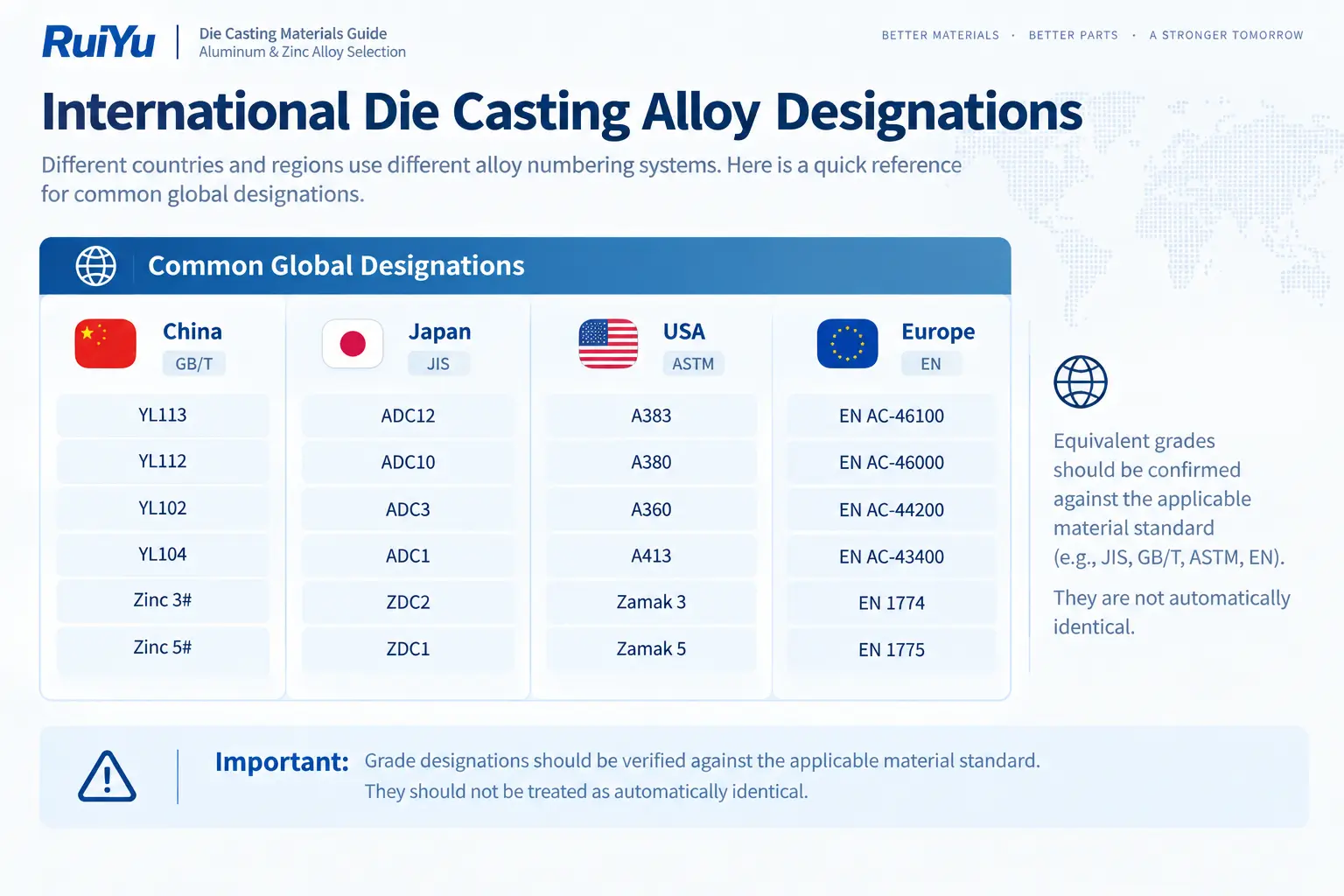
Commonly referenced designations in global sourcing:
| China (GB/T) | Japan (JIS) | USA (ASTM) | Europe (EN) | Key Characteristics |
| YL113 | ADC12 | A383 | EN AC-46100 | Excellent fluid filling for thin-walled complex parts. |
| YL112 | ADC10 | A380 | EN AC-46000 | Universal workhorse alloy; best strength-to-cost ratio. |
| YL102 | ADC3 | A360 | EN AC-44300 | Superior corrosion resistance and pressure tightness. |
| YL302 / YL301 | ADC5 / ADC6 | 518.0 / 515.0 | EN AC-51400 | Maximum corrosion resistance, marine grade, high toughness. |
| ZnAl4 (3# Zinc) | ZDC2 | Zamak 3 | ZP3 (ZnAl4) | Dimensional stability; industry standard for zinc hardware & locks. |
| ZnAl4Cu1 (5# Zinc) | ZDC1 | Zamak 5 | ZP5 (ZnAl4Cu1) | Higher hardness and wear resistance with 1% Cu addition. |
7.How to Use This Die Casting Materials Guide for Alloy Selection
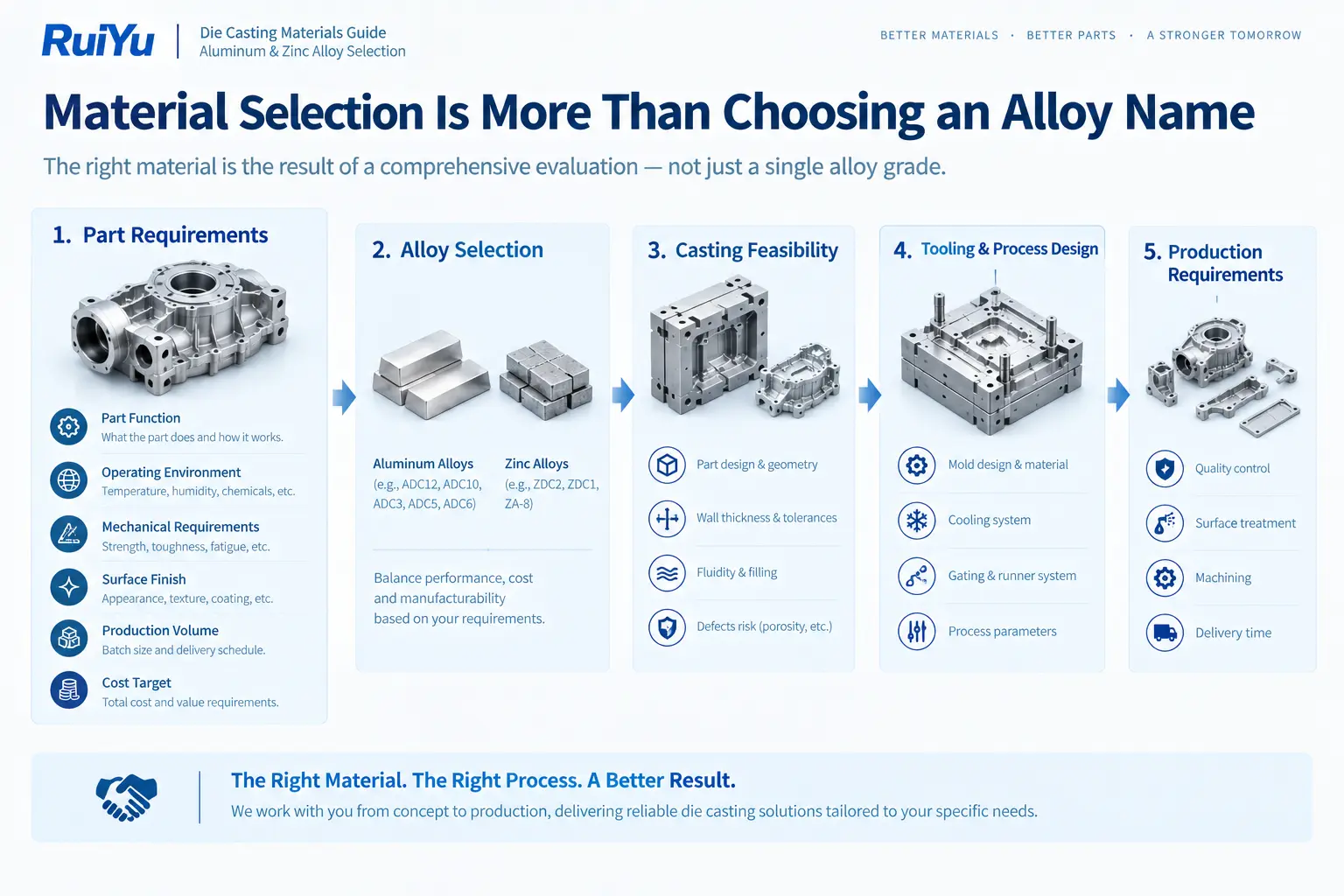
Use this quick-reference matrix to align your functional product requirements with the recommended alloy:
| Engineering / Product Requirement | Recommended Material | Primary Selection Driver |
| Heat Dissipation Enclosures | ADC12 / ADC10 | High thermal conductivity & thin-wall castability |
| Outdoor Lighting & Marine Valve Bodies | ADC3 (A360) | High corrosion resistance & pressure tightness |
| Marine Environment & Harsh Chemical Exposure | ADC5 / ADC6 | Superior salt-spray resistance & impact toughness |
| Precision Lock Components & Mechanisms | Zamak 3 / Zamak 5 | High dimensional stability & structural strength |
| Electroplated Hardware & Decorative Parts | Zamak 3 | High Corrosion Resistance |
| High-Load Mechanical Components | ADC10 / Zamak 5 | Superior yield strength and wear resistance |
| Cost-Effective High-Volume Parts | ADC12 / ADC10 | Globally available raw material & high processing efficiency |
| Premium Appearance Hardware | Zamak 3 | Excellent mold replication & high-end plating acceptance |
Related Manufacturing Process
After selecting a suitable alloy, material selection is only one part of the engineering process. Casting feasibility, part geometry, tooling design, machining requirements, surface treatment, and production requirements should also be evaluated before finalizing the manufacturing approach.
8. Related Custom Die Casting Services
Explore our manufacturing capabilities and tailored component solutions:
-
Custom Aluminum Die Casting: High-precision aluminum components for motor housings, lighting fixtures, structural brackets, and automotive enclosures.
-
Zinc Precision Die Casting: Tight-tolerance zinc components specialized for locks, trailer locks, and architectural hardware.
-
Surface Finishing & Post-Processing: Professional surface solutions including electroplating, powder coating, e-coating, anodizing, and precision CNC machining.
9. Need Help Selecting the Right Die Casting Material?
Share your product drawings, application requirements, or existing material specifications. Our engineering team can help evaluate alloy selection, casting feasibility, and cost-optimized manufacturing solutions.